
Egypt is synonymous with the Pyramids of Giza for most of us. Visions of golden, triangular structures soaring toward the vivid, blue sky dominate our imagination. But did you know that there are over a hundred pyramids scattered throughout Egypt? I was determined to visit as many as I could in just a day, along with a few tombs scattered in between.
Mid-February was an excellent month for sightseeing in Egypt. The weather was comfortable, tourism was down, according to our guide, by 70 percent, and lines were nearly non-existent into major archeological attractions. Tourists were apprehensive about the current fighting in the Gaza Strip caused by the recent attack on Jewish concert attendees by extremists. Unfortunately, Egypt suffered perceptions that it was unsafe.
We hired a guide to take us to several sites outside of Cairo. Road conditions were challenging. Signs were non-existent in the countryside and using GPS was sketchy according to our contact in Cairo. Paved streets turned into dirt paths, and folks walking alongside the road with donkey carts tended to dart out in front of oncoming traffic. A driver and guide cost $ 120.00 for the four of us. Tickets into the monuments were our responsibility.
Starting at 8:00 a.m. from our hotel, we boarded a private van. The thick, brown haze that seemed to hang in the early morning air began to burn off. We were going to have a clear day. We made our way out of Cairo, crossing the Nile. Taking Ring Road, which is the primary route to the Giza Pyramids, we passed residences that gave way to palm groves. My husband proposed a coffee break. Our guide, Sam, was aware of an establishment along the way. Nestled among palm trees and shrubbery, we found a small hut and indulged in Turkish coffee. Sam took charge of the order, presenting us with black, semi-sweet, or super-sweet coffee options. I chose the delightful, super-sweet variety; it had a slightly chalky consistency. Resuming our journey, I observed a bend in the road as it veered to the right. The road widened, and the blacktop seemed fresh. This part of the road was the newly inaugurated highway extension leading to the Giza Pyramids. Contrary to a popular portrayal in an Instagram post, the pyramids were no longer prominently visible through the windshield as this route took us parallel along the pyramid complex. The Tourism Route was constructed to accommodate increased traffic and alleviate congestion. The freshly laid blacktop road created a striking contrast against the golden desert landscape.
A few bus-loads of tourists had just entered the park ahead of us. Sam jumped out of the van with our husbands following to purchase tickets and beat the crowd. Lines were short, and in no time, Sam had us on our way, walking towards Khufu’s pyramid. We bypassed a group of enthusiastic onlookers, striking up a pose for that instant social media shot, and headed towards the mortuary temple of Khufu. It stood on the west side of Khufu’s pyramid. Faded reliefs decorated the exterior. We could make out the figures of men with a cartouche of the Pharaoh’s name between them. This was one site that helped archeologists understand who built the pyramid.
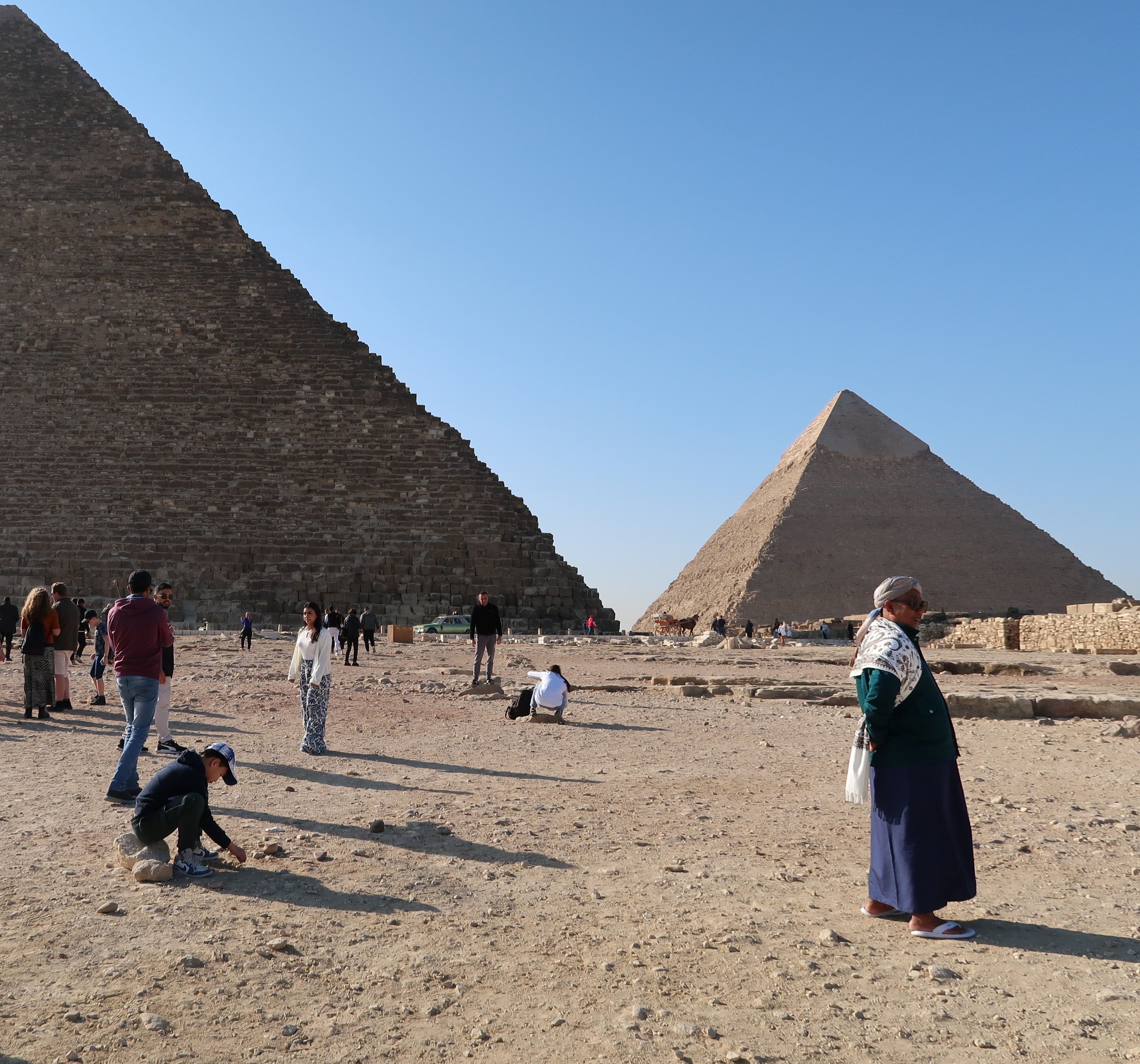
Making our way on the pyramid’s stone-strewn grounds, I noticed a pack of dogs roaming nearby. They had tags clipped to their ears. I asked Sam what they were for. He told us that the tags let people know the dogs had been vaccinated and were safe to pet. The dogs were not interested in approaching the tourists. They seemed to know that there wasn’t a handout waiting for them.
Walking around the pyramid’s base, we could climb up to the entrance leading into the inner chambers. Uneven steps in the stone created a path resembling an upside-down U, which allowed folks to climb the pyramid without entering it. Here, you could get a feel for the engineering scale achieved by the builders as you stood almost a third of the way to the top.
We declined to enter the pyramid for many reasons. Blank walls line the passage where cramped space leaves a person needing to bend down during most of the way. Air is limited, making breathing difficult, and the activity takes time. We decided that a camel ride near the pyramids would be more fun.
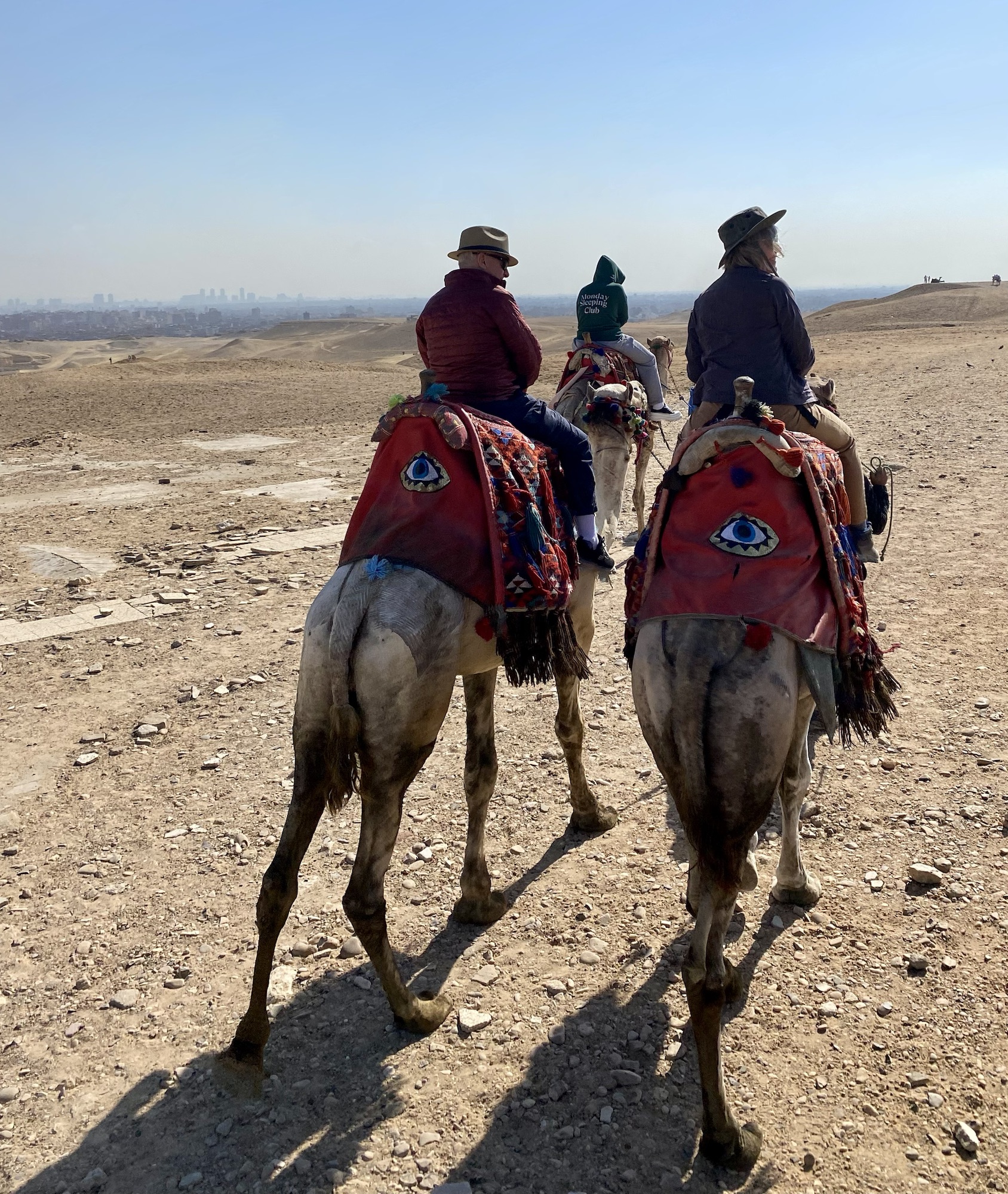
Located at the Panoramic View Point, we stopped to experience this iconic activity where caravans of camels sat on the ground, lazily munching fresh hay. Sam eliminated the hassle of negotiating a price and procured four camels for us. What an experience! Scenes of “Lawrence of Arabia” popped into my mind. I had always been enthralled by the expanse of the desert and riding a camel across it. Today, I was experiencing the sights, sounds, smells (camels are a bit stinky), and feel of this activity. The caretakers of the camels were considerate and cautious. The camels were content and offered an astonishingly smooth ride. For a half-hour, we rode in the desert, the pyramids of Giza standing majestically in the distance. For the most part, our camels were led on a rope by the camel driver, but at one point, the driver handed me the rope and I enthusiastically steered the camel on my own.
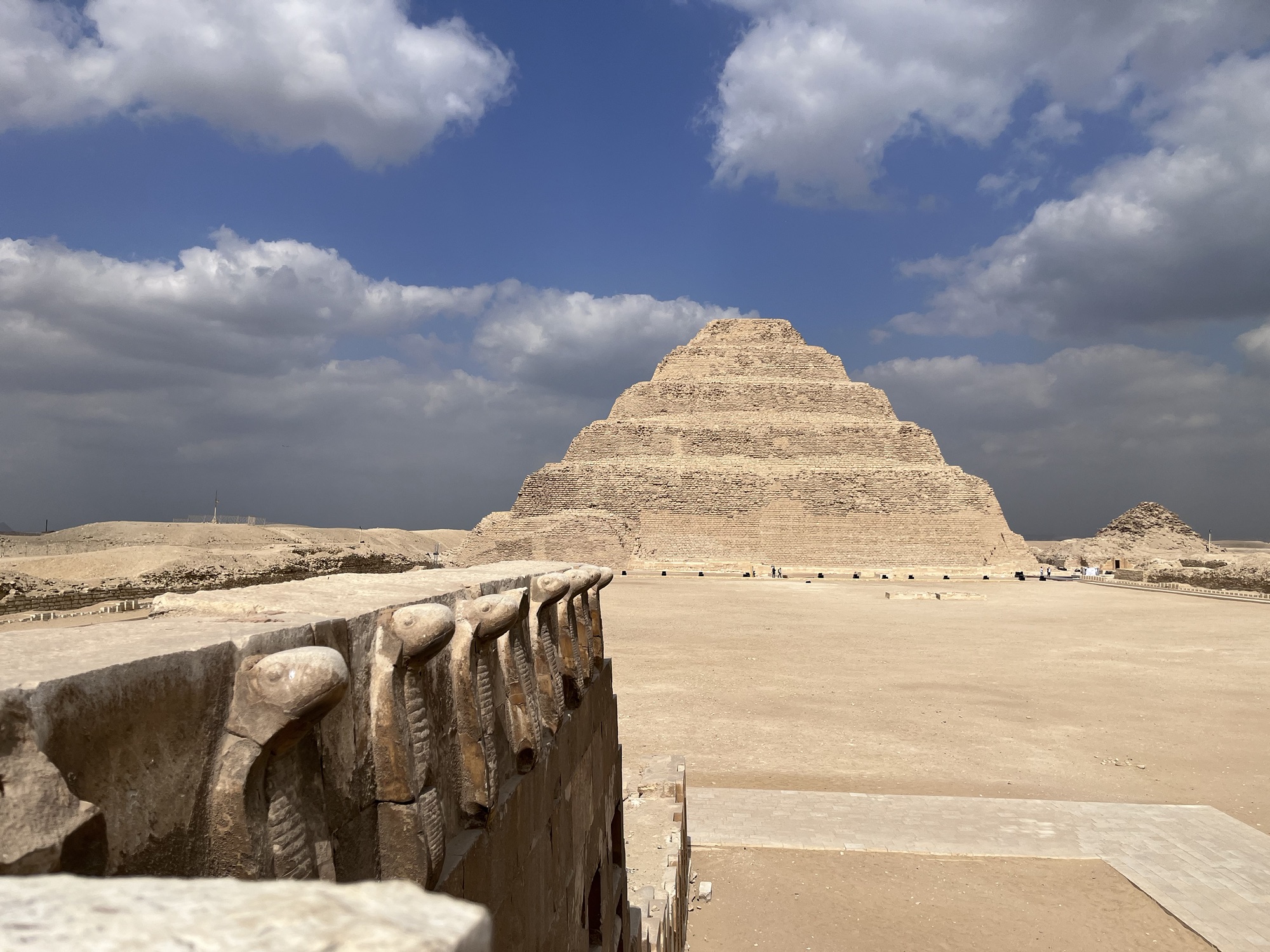
There were more pyramids to discover and soon we were on our way to the Saqqara Complex. My curiosity in Saqqara was prompted by a fascinating documentary titled “Secrets of the Saqqara Tomb” on Netflix. While digging at Egypt’s largest archeological site, archeologists discovered a well-preserved tomb. Man-size statues stood in niches along the walls. Vivid drawings decorated the tomb. Intrigued by this discovery, I learned that the Step Pyramid, Egypt’s oldest pyramid dating back to 2,670 BC, was at The Saqqara Necropolis. Saqqara and Dahshur had pyramids to explore, and Sam made sure our walk through these amazing outdoor museums would be memorable.
Saqqara is about a half-hour drive from the Giza Plateau. Tucked in the confines of our van, I watched as the dense housing around the Great Pyramids began to disappear, replaced by palm groves and lush green crops. Road conditions became more challenging when we turned off the Highway. The roads narrowed, and the pavement began to break up, eventually turning into dirt tracks along a canal. Garbage littered the canal banks and clustered on the water. Besieged with black-robed pedestrians crossing the road, donkey carts carrying produce, and Tuk Tuks weaving in and out of lanes, our driver was well versed in these conditions.
Once inside the Complex, the roads widened with new pavement. General admission tickets covered entrance fees with access to a few tombs or mastabas. Mastabas, I was informed, are Egypt’s earliest form of tomb. They are rectangular, low-lying structures with flat roofs made of brick or stones. We could access additional tombs for an extra charge.
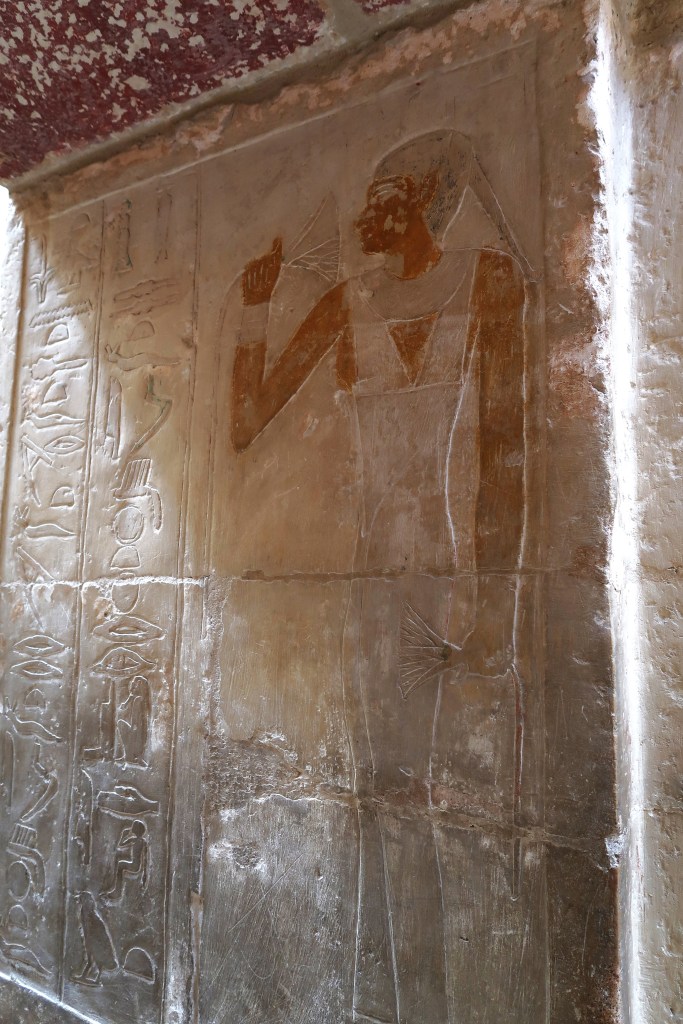

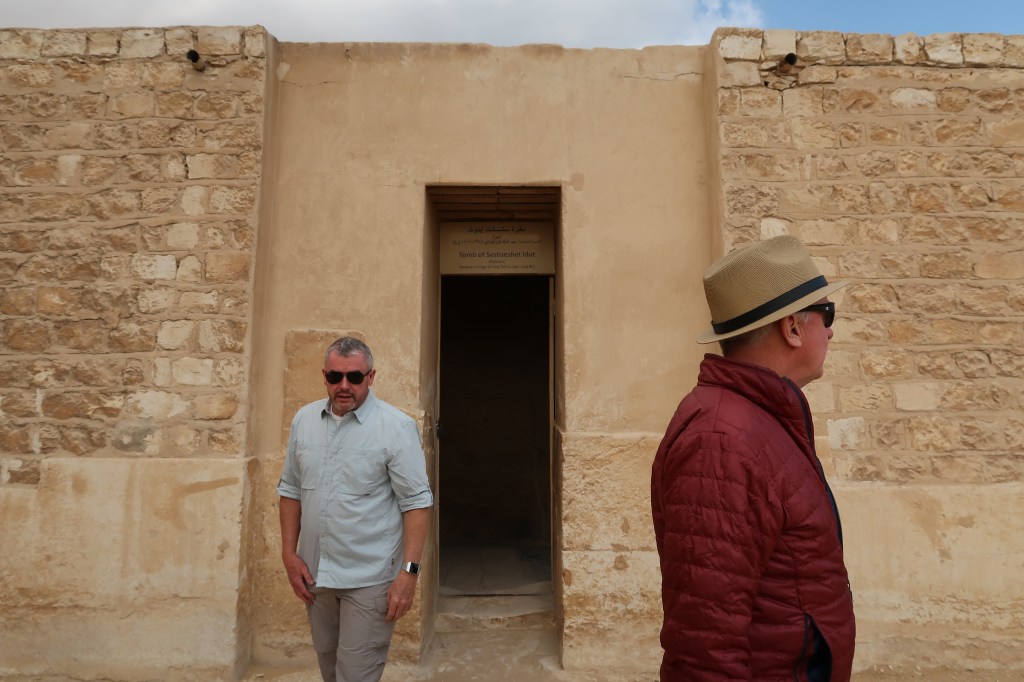
Enthusiasts could spend days at Saqqara, which spans 4 square miles or 2,560 acres. As we drove further into the complex, we passed an active dig. Men were hauling wheel barrel loads of dirt away from a limestone bank with several doorlike openings cut into the rock. Our guide told us these tombs were found only a few months ago. How exciting to see that there were still secrets to be uncovered in the desert!
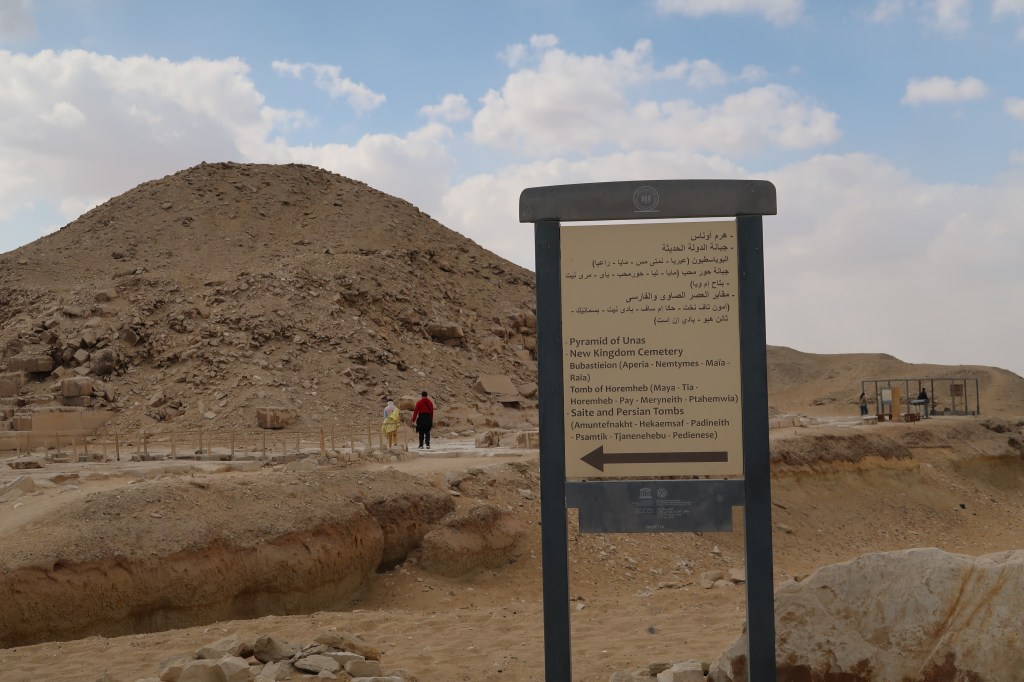
Because of time limitations, we could only see a handful of ruins. Our guide surprised us with an announcement that a “hard-to-get-into” tomb was open, and if we hurried, we could see it before it closed for the day. We crossed a large dirt field beside the Step Pyramid and circumvented the main causeway. Scattered at our feet were artifacts just lying in the desert. We walked by a low grey stone wall that served as a protective barrier around a shaft that plunged fifty feet or more into the ground. Sam said it led to another tomb. A short distance ahead was a mound of rubble. It was the Unas Pyramid.
The Unas pyramid had been closed for 28 years and reopened in 2016. Hieroglyphs carved into the walls became known as the Pyramid Texts. They are considered the oldest religious funerary writings available today and are a glimpse into the beliefs practiced for the afterlife.
On the south side, we descended a series of stone steps. A man in robes monitored the entrance. He checked our tickets. This tomb was an extra charge. Bending down to enter the low ceiling shaft, our guide suggested that we walk backwards down the steep slope. My girlfriend piped up behind me. “Is this how Indiana Jones entered tombs?” I chuckled.
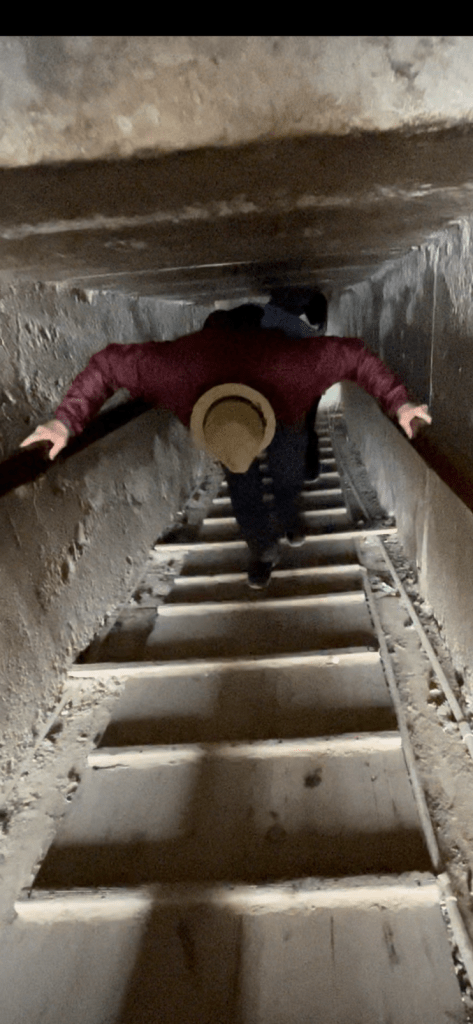
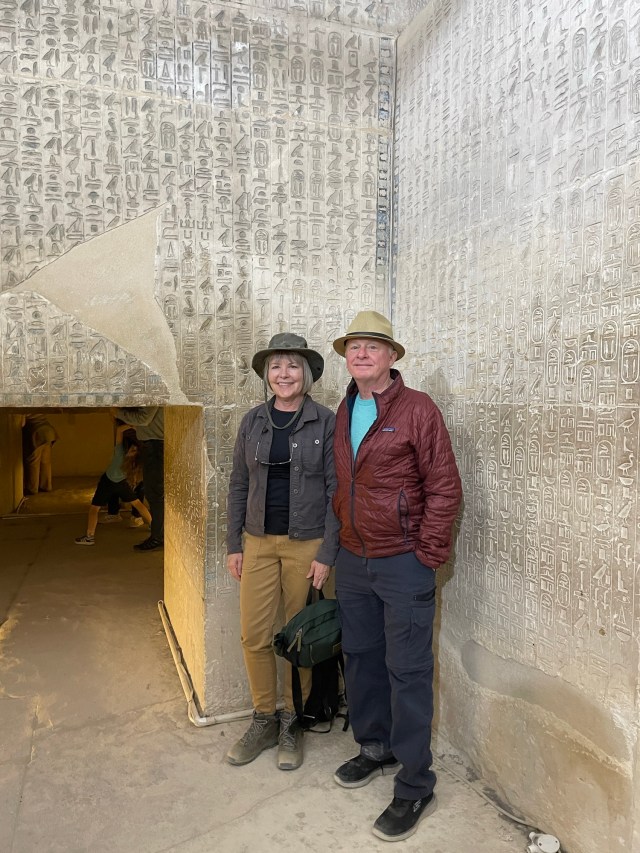
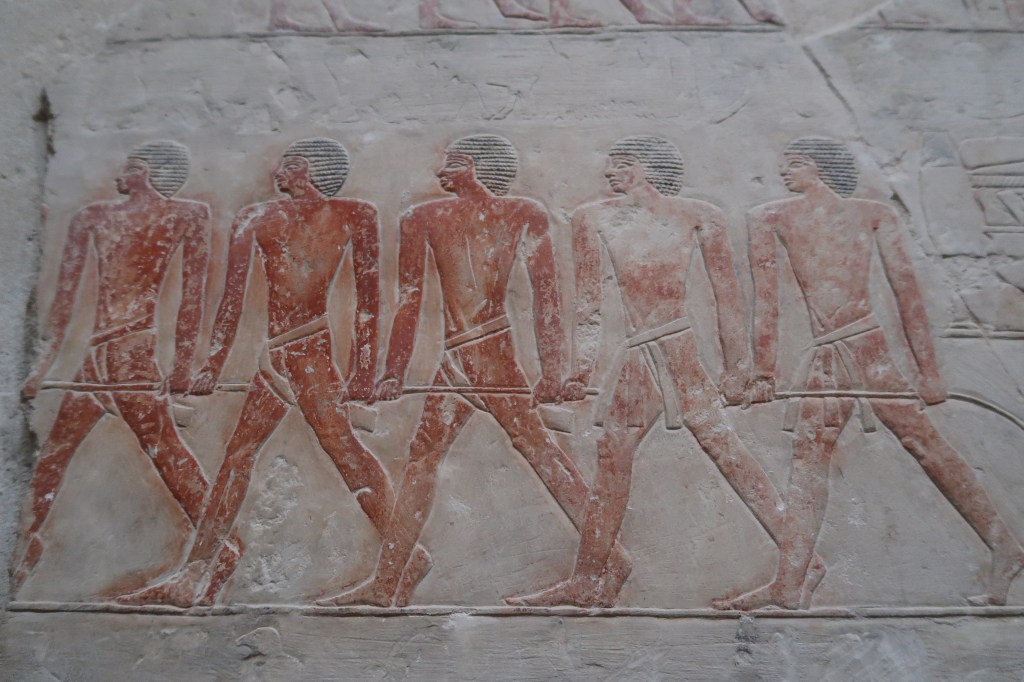
The slope of the shaft turned into a horizontal corridor. It was low and narrow. With our backs and knees significantly bent to get through, we eventually came to a spacious chamber. We were speechless. Hieroglyphs rained down from the high ceiling to the floor. They were sharp and defined as if they had just been carved. In perfect columns, symbols of birds, snakes, Giselle, ropes, feathers, reeds, and water waves aligned in patterns, telling us a story. Thousands of years from the past seemed to reach out to us in stoic silence. It is an experience that can only be marveled at in person.
Sam, an Egyptologist, pointed out the name Unas. It was written several times on the walls. The hieroglyphs were accolades, prayers, and guidelines for the deceased. One section began with “…To say by Nut, the brilliant, the great: This is (my) son, (my) first born, Opener of (my) womb; …this is (my) beloved, with whom I have been satisfied”.
There was more to see. We crawled through another low opening to find ourselves in another chamber. The mood of this room was entirely different. It somehow had an inner light that brightened the space. Patterns in an ethereal blue adorned the walls. Rare patches of yellows, greens, and reds added more color. Stars decorated the ceiling. This room was Unas’s burial chamber. A large, black granite sarcophagus weighing 72 tons sat at the back wall. Its lid was pushed to the side, the contents empty. A custodian in the chamber happily demonstrated the iridescent glow his flashlight created as he pressed the lamp against the stone panels. They were alabaster. Alabaster’s translucent qualities were associated with the divine, a prized stone cherished by the Egyptians.
After exploring further, we returned to the Step Pyramid, where we were greeted by the luminous blue skies and the golden stones. The Step Pyramid was constructed for King Djoser by his trusted advisor, Imhotep. Imhotep was an exceptional personality of his time, much like Leonardo DaVinci, who emerged thousands of years later. He not only designed the pyramid, which changed the way Egyptian Pharaohs built their funerary structures, but also served as the Pharaoh’s vizier. He was a physician, mathematician, astronomer, and writer. King Djoser was so grateful for Imhotep’s contributions that he had his name and accomplishments inscribed next to his for eternity.
After exploring a few mastabas on the grounds, we drove further inside the Saqqara Complex to The Serapeum. The dirt track faded into sand drifts. The driver was skeptical that his vehicle could navigate in such conditions, so we walked the rest of the way. Typical of the Sahara, the wind swirled playfully around us, creating mounds and gullies in the ground. Out of nowhere, a causeway appeared. It led into the side of an embankment. Stone steps led underground. We entered the Serapeum.
The Serapeum was discovered by the French archaeologist Auguste Mariette in 1850. After years of excavation, it was revealed that it was built for the Apis Bull, which was considered sacred in ancient Egypt. Once the bull died, an elaborate funerary ceremony was conducted, and the search for another bull began.
The Serapeum originally had isolated burial vaults and was developed around 1400 BC. However, it later expanded into a network of tunnels. The Greater Vaults, which are open to the public today, were constructed under Psamtik between 664-610 BC. They showcase 24 granite sarcophagi, each in its own chamber. These black granite boxes weigh between 70 and 100 tons.
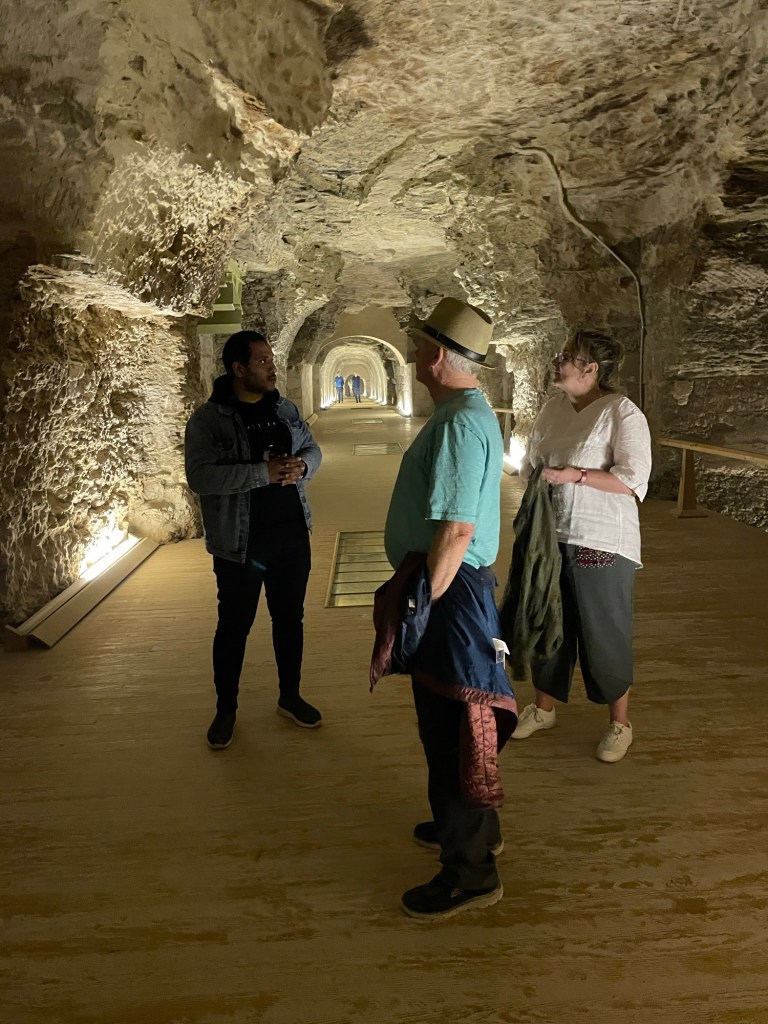
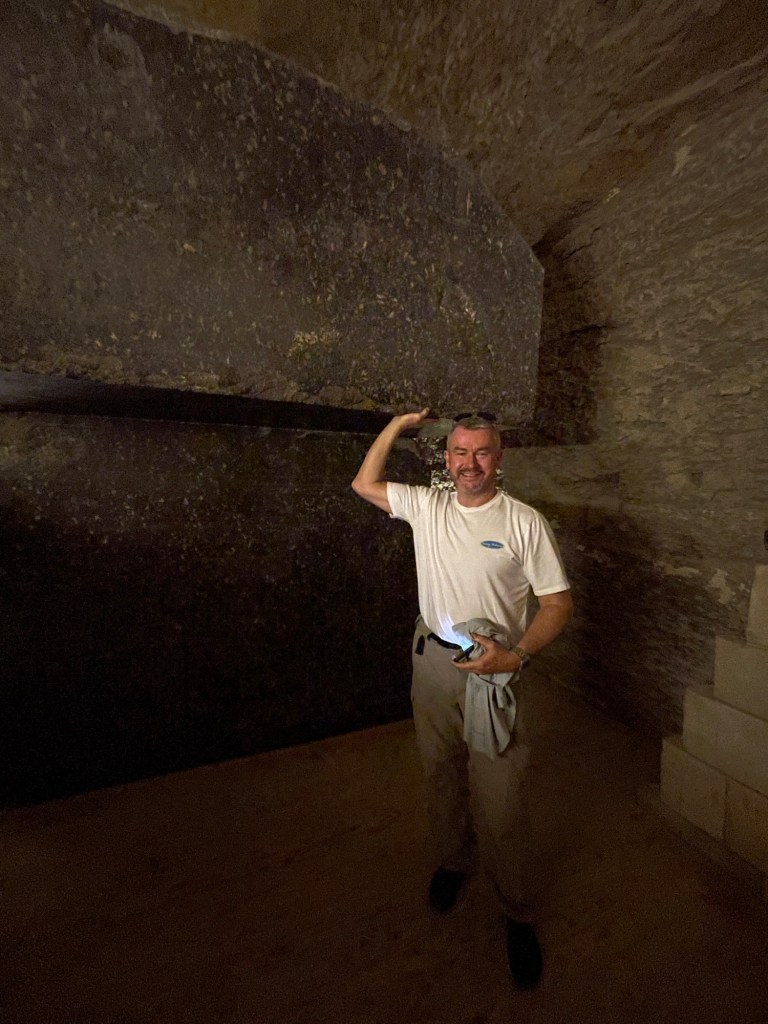
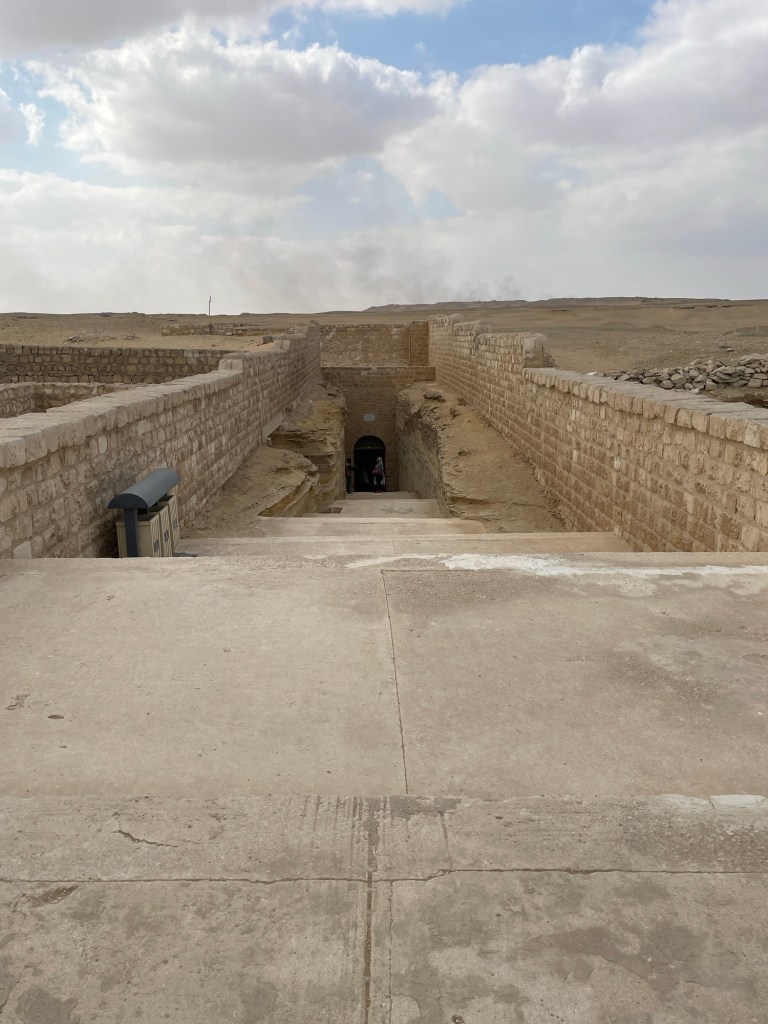
The effort the Egyptians went through to develop this underground complex is astonishing. So many questions are raised. How did they cut these granite boxes with perfect 90-degree angles? Why didn’t they use lighter material for the coffins? What did they use for light sources in this array of tunnels? I was so curious that I started scanning the internet for more information. I encountered some wild theories and speculation, but I eventually found Mariette’s journal written during his excavation. The link is listed below.
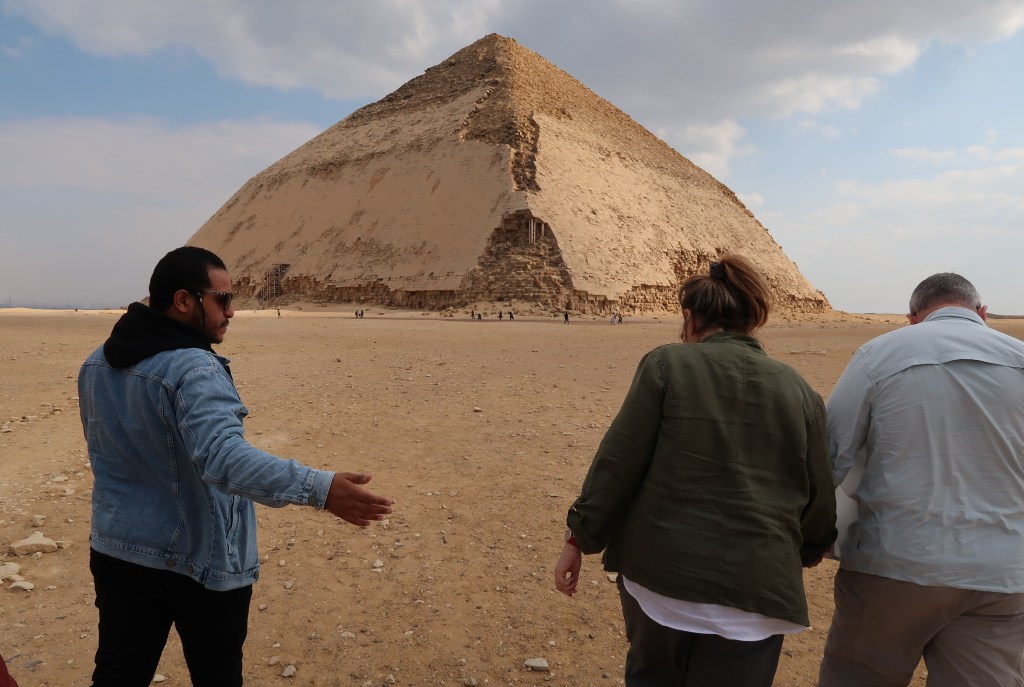
Dahshur was our final destination for the day. The Bent and Red Pyramid were located here. A small, yellow stucco building stood off to the side of the road. It may have been someone’s house, but for the sign that said Dahshur Monuments. It was the ticket office. Once inside the park, the road turned into a newer paved street that snaked its way to the Bent Pyramid. There were just a few cars in the parking lots by the pyramids. The desert was immense and isolated. We had finally left the buzz of tourism behind.
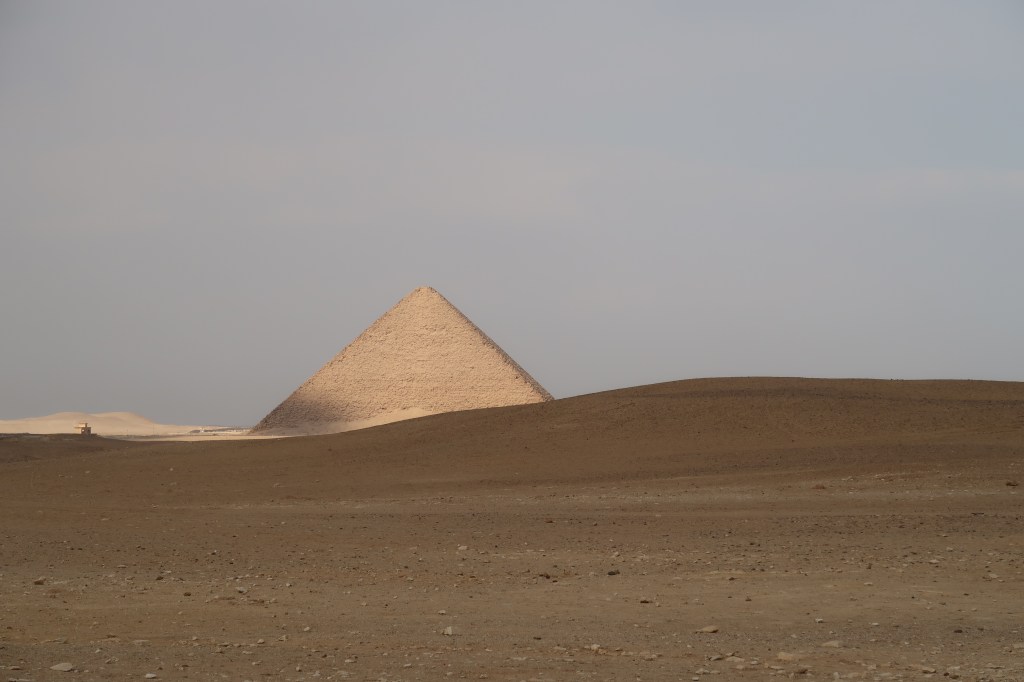
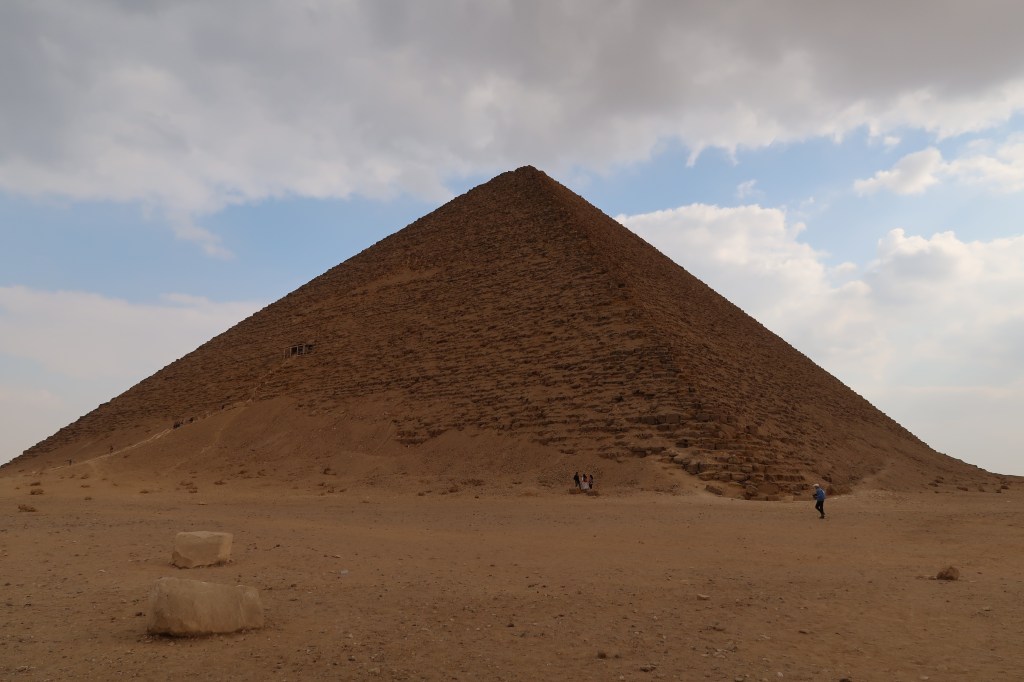
The Bent Pyramid was the first attempt to create a structure with sloping sides. Built under the direction of King Snefru in the 4th Dynasty (2575-2465 BC), a miscalculation on the angle of the slopes caused a design change further up, creating a bent appearance. King Snefru was not one to give up. Another pyramid structure was built with again structural flaws. The slopes attained structural integrity on the King’s third attempt, reflected in the Red Pyramid. The Red Pyramid set the standard for pyramids thereafter.
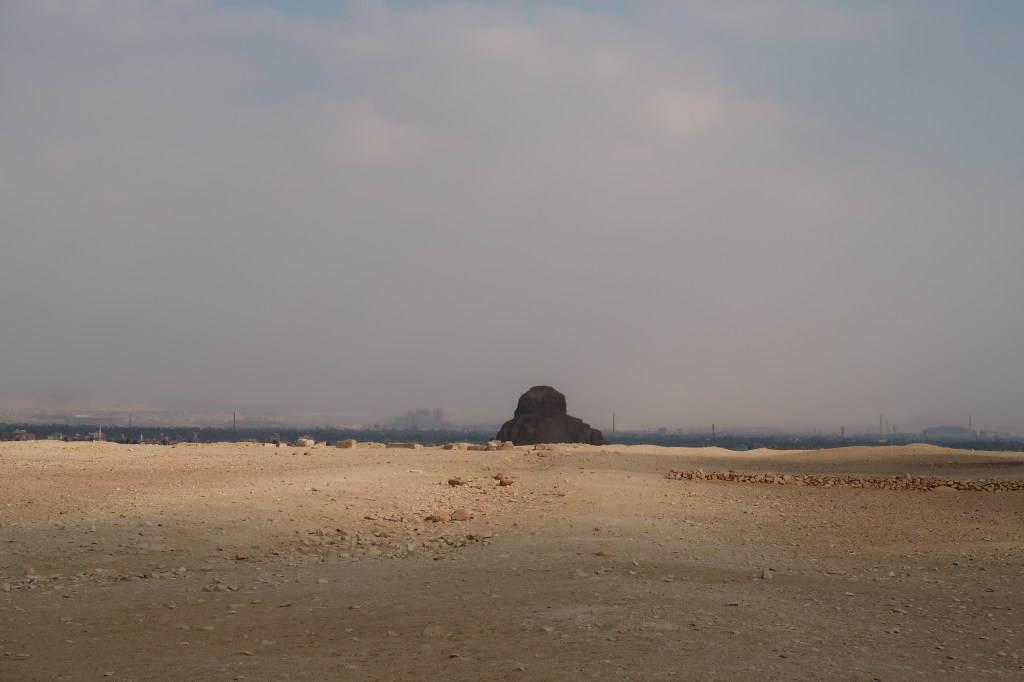
During our visit to Dahshur, we had the opportunity to explore several pyramids. Among them, we saw the infamous “Black Pyramid” and caught a glimpse of the pyramids of Senurset III and Pepi II in the distance. While the inside of the Bent Pyramid and the Red Pyramid are open, we decided not to explore them since there is nothing to see inside. To access the inside of these pyramids, one has to climb stairs that zig-zag up the slopes of the structure.
Exploring the vast ruins in the Egyptian desert is an overwhelming task that cannot be completed in a single day. We had limited time to spend in Egypt, so we had to prioritize and decide what we wanted to see. Fortunately, we were able to gain access to rare tombs like Unas, but the Egyptian government is increasingly limiting access to these artifacts to preserve them. As tourism increases, many monument areas worldwide are taking similar measures to limit the number of people in their parks. These are essential factors to consider when planning a trip.
Timing is important when planning a trip. February was a good choice since it was a bit warmer than December or January. It was also a good month to avoid peak tourist traffic during Christmas and spring break. We were worried about the conflict in Israel and how it might affect our safety in Egypt. To ease our concerns, we registered with the Smart Traveler Enrollment Program (STEP), a free service for U.S. citizens traveling abroad to enroll in their trip with the nearest U.S. Embassy or Consulate. By signing up, we would receive alerts on our cell phones that could be located in case of an emergency. While we found some comfort in taking these steps, we also learned that Egypt was taking measures to keep tourists safe. Below are some links for more information and planning.
egymonuments.gov.eg (your source for current ticket charges at Egypt’s attractions)
GVentures on YouTube for current trends and travel in Egypt
sacred-texts.com/egy/pyt/index.htm
Travel.State.Gov
 Traveling with family & friends and the Power of Prudence
This article beautifully showcases the wonders of Egypt! The photos and descriptions truly capture the magic of this incredible destination. From the majestic pyramids to the vibrant culture, Egypt offers an unforgettable experience.
I’d like to add that while Egypt boasts incredible beauty, it’s understandable that travelers also prioritize safety. We at [Pharaohs Tours] understand this concern and prioritize the well-being of our guests on all our tours. We work diligently with local authorities and experienced guides to ensure safe and enjoyable travel experiences. We believe that exploring Egypt’s rich history and stunning landscapes should be a secure and worry-free adventure.
Thanks for this great article.
LikeLike