
Luxor felt like a peaceful retreat after facing the frenetic pace of Cairo. I was happy to power through the next stage of our travel which involved embarking on a domestic flight that required two security checks (body pat-downs included) and hauling my carry-on luggage across the tarmac (Luxor’s airport terminal has no jetways). By the time I arrived in Luxor, I was ready to sink into a comfortable lounge chair and enjoy a strong drink!
At the hotel, I was delighted to see plenty of empty chairs around the pool and overlooking the Nile. The late afternoon was, without question, slated for relaxation. Meeting our friends by the pool, we grabbed four lounge chairs near the river’s edge. There was a pleasant “hush” in the air as the sun hung near the horizon, casting a golden path over the water. I watched a small fishing boat slowly float by, turning sideways in the current, the rudder unmanned, a single occupant pulling his net into the boat. Was it possible that I was witnessing something as common four thousand years ago as it is today? Egypt was a mix of ancient ways and modern madness that, oddly enough, seemed to work. With a Cosmopolitan in hand, I toasted the evening with my friends. “Was that fruit punch and vodka I was drinking?” It seemed that my husband and our friends made a better choice as I watched them thoroughly enjoy a local beer.

I woke to a morning bathed in sunshine and the melodies of birdsong. My husband and I leisurely sipped coffee on our private balcony and watched the river slowly flow north. Beyond the river stood fields of verdant green crops, their long stalks fluttering in the breeze. I soon found out that the plants were sugarcane. Behind them rose barren cliff walls shrouded in a blue haze. Later, I discovered that the burial chambers of kings were hidden in those cliffs.
It was going to be an easy day of touring. I hired Luxor & Aswan Travel, which was recommended by a friend back home. The company would tailor our tour to our preferences and allow us to be flexible. Although we liked to travel with as much independence as possible, hiring a local guide was an efficient way to cover unfamiliar territory, obtain more information about our surroundings, and engage with a resident.
Our guide, Safwat, met us in the hotel lobby. He was a tall, fit man in his fifties who lived in Luxor and was well-versed in what Luxor had to offer. We were scheduled to cover two famous temples – Karnak and Luxor. “Why was Karnak Temple such a big deal?” I had asked myself. It was Egypt’s second most visited sight, right behind the Pyramids of Giza. Safwat would shed some light on this question.
As we drove to the west bank of the Nile, Safwat gave us a brief history of Karnak. It was a religious complex that thrived for almost two millennia, making it remarkable. Karnak was Egypt’s most important religious center, as it served as the epicenter for the triad of gods Amun-Ra, Mut, and Khonsu. From the Middle Kingdom to the Ptolemy dynasty, the pharaohs used Karnak to honor gods and assert their political power. Each king added pylons, temples, shrines, obelisks, and statues of themselves to the complex. Safwat mentioned that Queen Hatshepsut built the tallest obelisk in the complex. She was determined to show her people that she was a great and powerful ruler. However, her reign was almost erased from history. After her death, there was a concerted effort to remove the queen’s name from all official records. Was it politically motivated? Was it because she was a woman, and the country had seen prosperity and peace under a female’s reign? Defacing her name could also affect her in the afterlife according to religious beliefs. She would perish permanently, never to rise in the underworld. In this case, the following pharaoh, Thutmose III, was guaranteed that her death was absolute. Fortunately, not all writings were destroyed, so we know today that she was one of Egypt’s most successful leaders.

When we arrived, I saw groups of tours gathered at the first pylon and main entrance into the complex. Safwat cleverly guided us away from the crowds and took us into the Avenue of Sphinxes that connected Karnak and Luxor Temple. The wide avenue was empty. “Imagine the procession that used this avenue, making its way to the Temple,” Safwat said. Flanked on each side of the stone walkway were ram-headed sphinxes with a small statue of Ramesses standing under the jaw. The thoroughfare was a stately prelude to the magnificent structures at the end of the promenade. “Why ram heads?” I asked. Safwat answered that the ram embodied the Sun god Amun. In 1949, these ram sphinxes were discovered buried under the sand. It took 70 years for their restoration. On November 25, 2021, a grand celebration occurred with a parade and fireworks; the President of Egypt attended, dedicating the avenue to its original state.
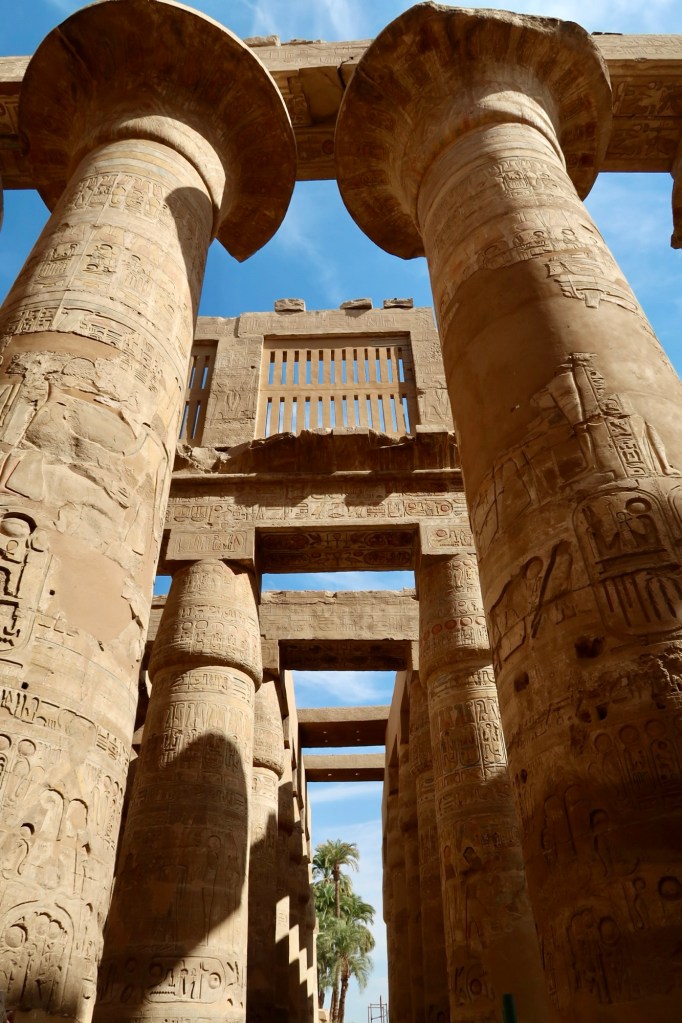
Today, only the Amun-Ra portion of the complex is open to visitors. It’s extensive in itself. Six sets of towering walls create a sense that you are passing through gates. Courtyards span out before you. 70-foot columns soar overhead. Their aesthetic shapes imitate papyrus. A Hypostyle Colonnade Hall contains 122 columns and is the most visited part of the complex. It is also one of the most filmed locations in Egypt, seen in such movies as Death on the Nile, Cleopatra, Transformers, and The Mummy Returns. I can understand why. The visual impact overpowered my senses. My attention to Safwat’s narrative began to fade in and out. Barely hearing his remarks that Egyptologists believed that there was mathematical and astronomical significance in the Hall or that the stone roofing over some of the columns weighed an incredible 70 tons, I couldn’t help but imagine wandering with the priests and pilgrims who certainly visited these rooms.

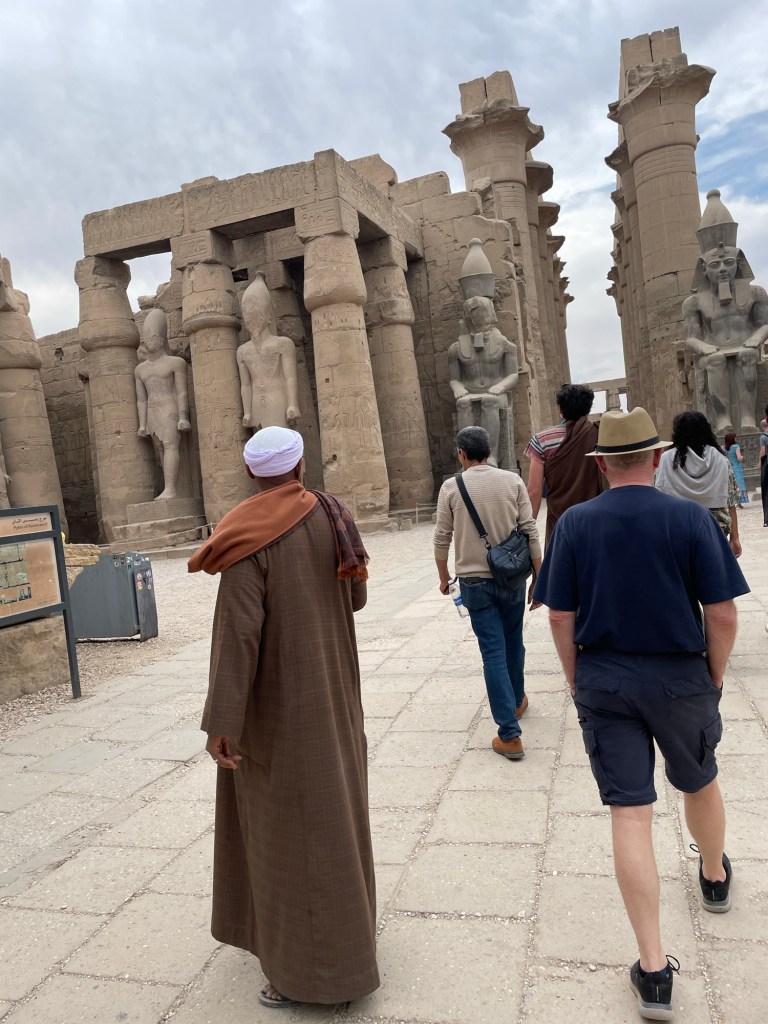
Safwat, keen to keep us engaged, led us to the rear of the complex where a sacred pool was located. Filled with water that was diverted from the Nile, the pool was used to predict the flood and sanctify the pharaohs. He then directed us to another courtyard, suggesting some free time to explore. Jim and I proceeded to the back of the complex, where there were fewer people. Climbing a dirt mound, we were offered a panoramic view of the temple. Structures became visible that would otherwise be overlooked, and the vastness of the area became more prominent.
My eyes followed the mud-brick walls that enclosed the complex and I noted that some of the gates stood alone where the wall had crumbled. These gates rose 50 to 70 feet into the air. The outer walls had historical reliefs depicting the victories of Seti in Palestine and Ramesses II defeating the Hittites at the Battle of Kadesh. When I was ready to descend the mound, a guard standing nearby offered assistance down the narrow, uneven path.
Guards and docents were positioned throughout the complex, discreetly monitoring the archeological site. They stood stoic yet protective, seeming to have made a pact with the ancients, assuring them that Egypt’s history would be remembered. I too found myself affected by a reverence for this civilization that invested so much of its strength and time to build these lasting structures. I wondered who would stand by our legacy someday, ensuring that we would not be forgotten.
Driving to our next attraction, we followed a wide, modern boulevard. Luxor’s streets were clean and less congested. I appreciated the more “laid-back” attitude. Upon approaching Luxor Temple, I noted that it was smaller than Karnak but no less interesting. Luxor was peculiar because it was nearly buried under the sands of time. Layers of earth and silt from the Nile built up, leaving only the tops of columns protruding from the dirt. Village homes were built on top of the complex; even a massive church stood on a mound, unaware of the ancient ruins beneath it.
Safwat initially guided us to a small, black locomotive tucked into the corner of the visitor center. I didn’t expect to view this relatively modern-day machinery as necessary to Luxor until Safwat explained its vital usage in excavation. The excessive amounts of soil to be removed for the Luxor Temple were too great for simply using manpower. Railroad ties advanced deeper into the complex as tons of earth were removed.
We continued our tour, walking up to the massive walls fronting the temple. The consensus was that the temple was used by the Pharaohs as a place of coronation. Carved in black granite, Ramesses II sat on both sides of the entrance, his gaze seeming to access his lands. A tall obelisk stood on the left in front of Ramesses II. Its twin once stood on the right, but it was removed in the 1800s by then Egypt’s leader, Sultan and Viceroy Mehemet Ali, and sent as a gift to France. That gift stands today at the Palais de Concorde in Paris.
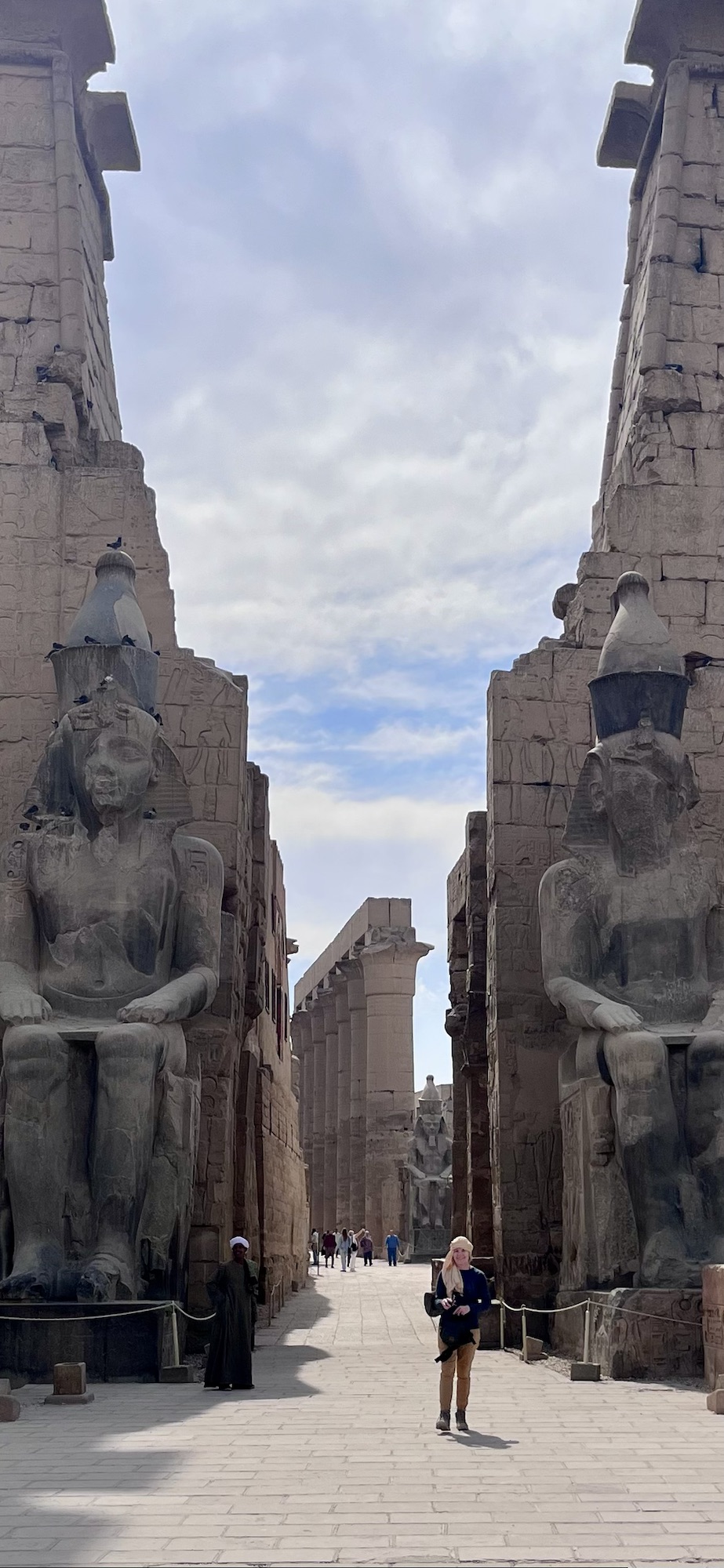

As with Karnak, many pharaohs added to or restored the temple, but the statues are exceptional here. Because the temple was almost completely buried for a long time (no one knows how long), the structures have benefitted from a type of preservation effect. The pharaohs of Amenhotep III, King Tutankhamun and his queen, and Ramesses II are exceptionally prominent and are a delight to see.
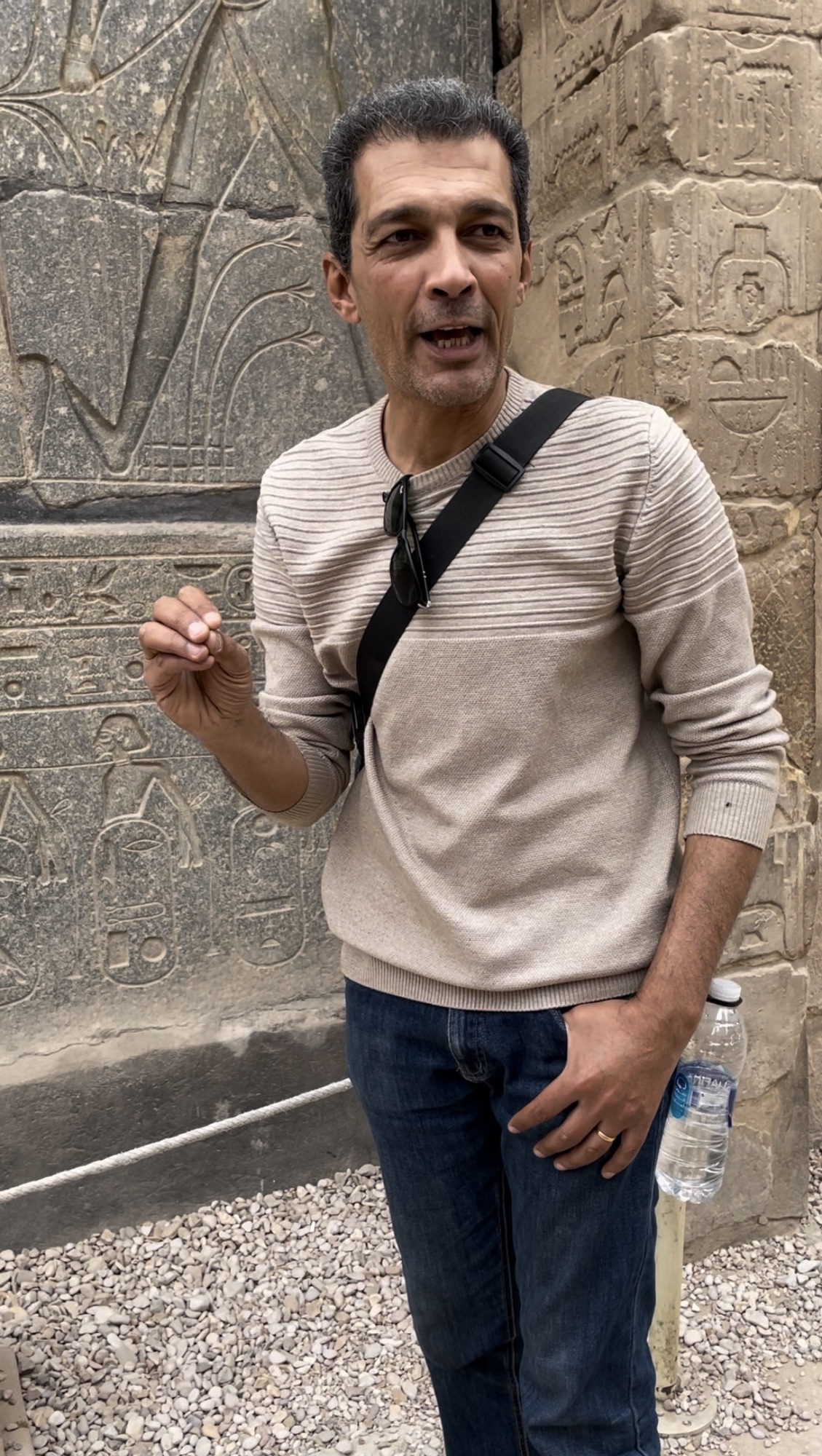
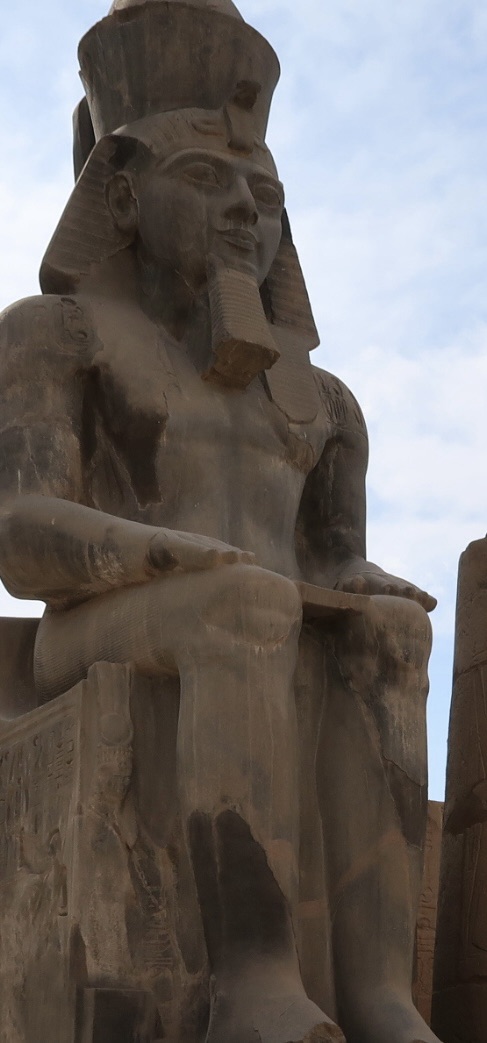
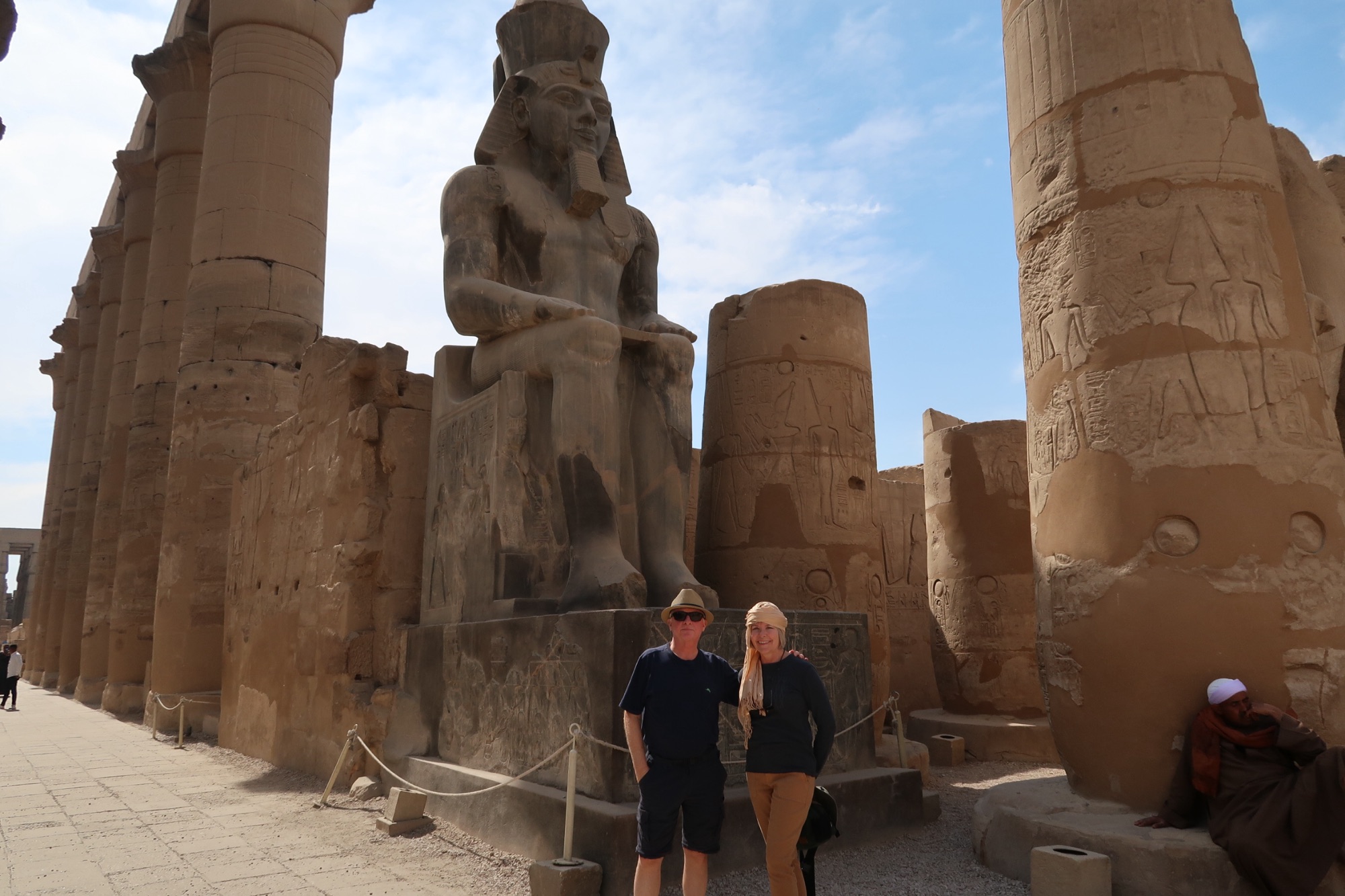
Tourists started retreating to cooler locals as the sun grew hotter, leaving the temple less crowded. Safwat took his time to explain the symbolism carved into the base of a sitting Ramesses. We were looking at one of the few places where the god Hapy was honored. Depicted as a pregnant man (now that’s a pretty progressive idea!), Hapy embodied the Nile’s seasonal inundation and the fertile soil that came with it. He was looked upon as having life-giving, creative abilities. By Ramesses, he stood in dual form holding both the papyrus and lotus stems, showing onlookers the unification of the upper and lower Nile.

We had time set aside to roam the complex by ourselves. I enjoyed these private moments to stop and soak up the imagery that bombarded my senses. I walked up to a sitting King Tut and his wife, Ankhesenamun. They looked young and happy. The statues were one of the few representations of the pharaohs that seemed more alive, expressing real emotions.

We were about to conclude the tour at the archaeological site. The intense heat had taken its toll, and I was eagerly anticipating a refreshing break. However, as we made our way out, the shops lining the pathway caught my attention. They were displaying various souvenirs, including embroidered clothing, exquisite scarves, alabaster, and trinkets made in China. I couldn’t resist the temptation of exploring these shops and finding a turban-style scarf to wrap around my head. I knew that scarves were incredibly efficient in protecting your head and face from heat and dust.
I veered off into one particular shop while the rest of my party, unbeknownst to them, continued to walk away. My eye had caught a beautiful, soft, muted gold, scraf. I asked the shopkeeper, “How much?”
“One thousand Egyptian pounds”, was his response. Hmm. That was around thirty dollars according to my calculations. I paused. Suddenly, Safwat was behind me, reminding me he could always get a better deal. I let him take over. I watched as the haggling commenced. He brought the price down to nearly half, and to my surprise, a second one was offered for free. A two-for-one deal. Wow! I’m glad he sought out one of his wayward people.
The evening descended upon us quickly. Curious to find a restaurant in town, we asked Safwat if he had any recommendations for dinner. “It depends on what you’re looking for,” Safwat replied. We wanted Egyptian cuisine. For a good view of the Luxor Temple lit up at night and decent food, he suggested Aboudi Break. El Hussein Restaurant was another option. Popular for its Egyptian dishes and within walking distance of our hotel, we decided on El Hussein.
After a short rest at the hotel, we walked to the restaurant. The street was busy with activity. Women dressed in dark burkas crisscrossed the street, carrying grocery bags. Men lounged in open bars, and someone occasionally approached us, trying to offer information with the possibility of gaining a little baksheesh. We were relieved to get inside the restaurant and enjoy a peaceful moment. Guided to the second floor, we had a nice view of the street below. The staff was helpful. I noted that Egyptian cuisine appeared to follow a simple process for preparing meals: slaughter a cow or lamb, season the meat, cook it over an open fire, and serve it. The mixed grilled meats, lentil soup, flatbread, and lamb were a favorite with us.
The day marked the beginning of a three-day journey with Safwat which only got better with every subsequent experience. Formal barriers between us began to melt away and an honest conversation ensued. Below, I have provided links to the businesses we used. I must say, each one of them was truly remarkable.
Hany.eldosouki@luxorandaswan.com or Luxorandaswantravel.com
safwatgayed@gmail.com (this is a direct contact to the Egyptologist employed by Luxor and Aswan Travel
El Hussein Restaurant found on TripAdvisor
 Traveling with family & friends and the Power of Prudence