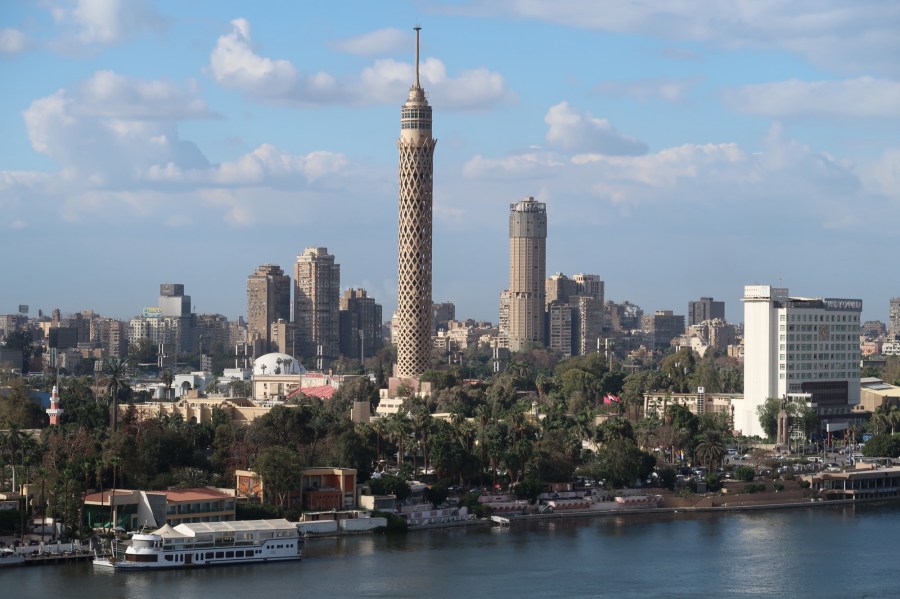
Cairo, Egypt, is not for the faint-hearted. The fast paced, bustling city blared into my senses after disembarking from the relative quiet of the jetliner. Emerging from the terminal at Cairo’s International Airport at 11:00 PM on the 16th of February, my husband and I were greeted by a sea of cars weaving in and out of traffic, creating their own lanes without apology. I was thankful I hired a driver to greet us inside the airport. He had quickly gotten us through customs, although there was a moment of some anxiety as he took our passports, asking us to wait as he disappeared down a hallway. We stood against a wall, watching the only customs booth slowly manage a sea of people getting their passports checked. I felt contrite when our driver returned with our passports stamped, and we were able to bypass the line.
On the curb outside, we jumped into a cab and headed to our hotel. The roads were jammed with vehicles, and I wondered if anyone slept in this city.
I had watched videos posted on YouTube by enthusiastic travelers journeying across Egypt, but nothing could prepare us for Cairo. I thought, “welcome to Egypt, where the chaos is as vibrant as the history!”

Like most metropolitan cities, Cairo has its good and bad areas. It is steeped in historical events reflected in the ancient buildings that still stand, yet it strives to recreate itself into a modern twenty-first-century metropolis. We had the opportunity to see both sides of this astounding city with the assistance of a generous local resident.
Hany and an aspiring young engineer met us after their work hours the following day and drove us around. We had connected with him through a mutual friend back home. Living and working in Cairo for most of his life, he was excited to show us the improvements facilitated by the current government. We drove by areas where unsafe structures had been demolished. The rubble lying on the ground. We took new highways curving up along plateaus away from the city, saw modern housing developments in the form of eight-story multi-family units, and drove alongside a twenty-eight-mile monorail line that will connect East Cairo to the new administrative Capital that is under construction 45 minutes east of Cairo. Eventually, we arrived at Festival City, a modern, expansive mixed-use development featuring single and multiple-family housing, offices, retail outlets, dining options, parks, and entertainment venues.
Our tour concluded at Festival City Mall, where we enjoyed dining at a Lebanese restaurant. The mall is nestled in a tranquil area of Cairo known as New Cairo. Offering a fountain show, with shopping, a cinema, and a variety of restaurants, my husband and I appreciated the opportunity to escape the bustle of downtown Cairo. Sitting on the second floor of the restaurant, we had a bird’s-eye view of the fountains and listened to the music that coordinated with the dancing water. As for the cuisine, it was simply delightful. We tried grilled meats, vegetables, hummus trays, and local drinks. The waiters were attentive and helpful. It was a relaxing evening as we conversed and shared impressions and experiences with our host. We are truly grateful for this glimpse into Cairo and the time spent with Hany.
Earlier in the day, we had seen a different side of Cairo. Hustlers, hawkers, and generally intrusive people approached us as my husband and I wanted to take a stroll over to the nearby Egyptian Museum. Taxi drivers insisted that our walk was “dangerous” and that we should hire them. (I had conferred with our hotel concierge about getting to the museum. It was a very easy 10-minute walk.) Near Tahrir Square, a well-dressed man began walking with us, striking up a conversation, wanting to know where we came from and where were we headed. My husband replied to the Egyptian Museum. He insisted that we shouldn’t cross the road and that he would show us an underground link. He was persistent. I said that I wanted to spend time at the square, taking pictures. He finally left. Another man approached us as we paused near the museum looking for the main entrance. He asked if he could help us. He pointed out the main entrance but said the museum was only open to tour groups. After 12:30, it opened to the general public. We had an hour to wait according to his information. “What were we going to do with our time?” he asked. He pointed out a gift shop across the street and said that he would be happy to walk us over there since there were no pedestrian walkways or stoplights on the street. We agreed. Was it a setup? Probably, but we did enjoy the shop and bought a few things.
I guess some things never change in the East as I recalled a book I had read about Middle Eastern travel. In Paul Theroux’s, “The Great Railway Bazaar”, Mr. Theroux recounted his days traveling by train across Europe to Asia and Africa . I became familiar with the word, “baksheesh”. Theroux was pestered by this custom throughout his travels. Baksheesh is a tip expected by a person when he is generously offering information or a favor. Unfortunately, this frequent behavior had us fairly agitated. It was something that we were not used to.
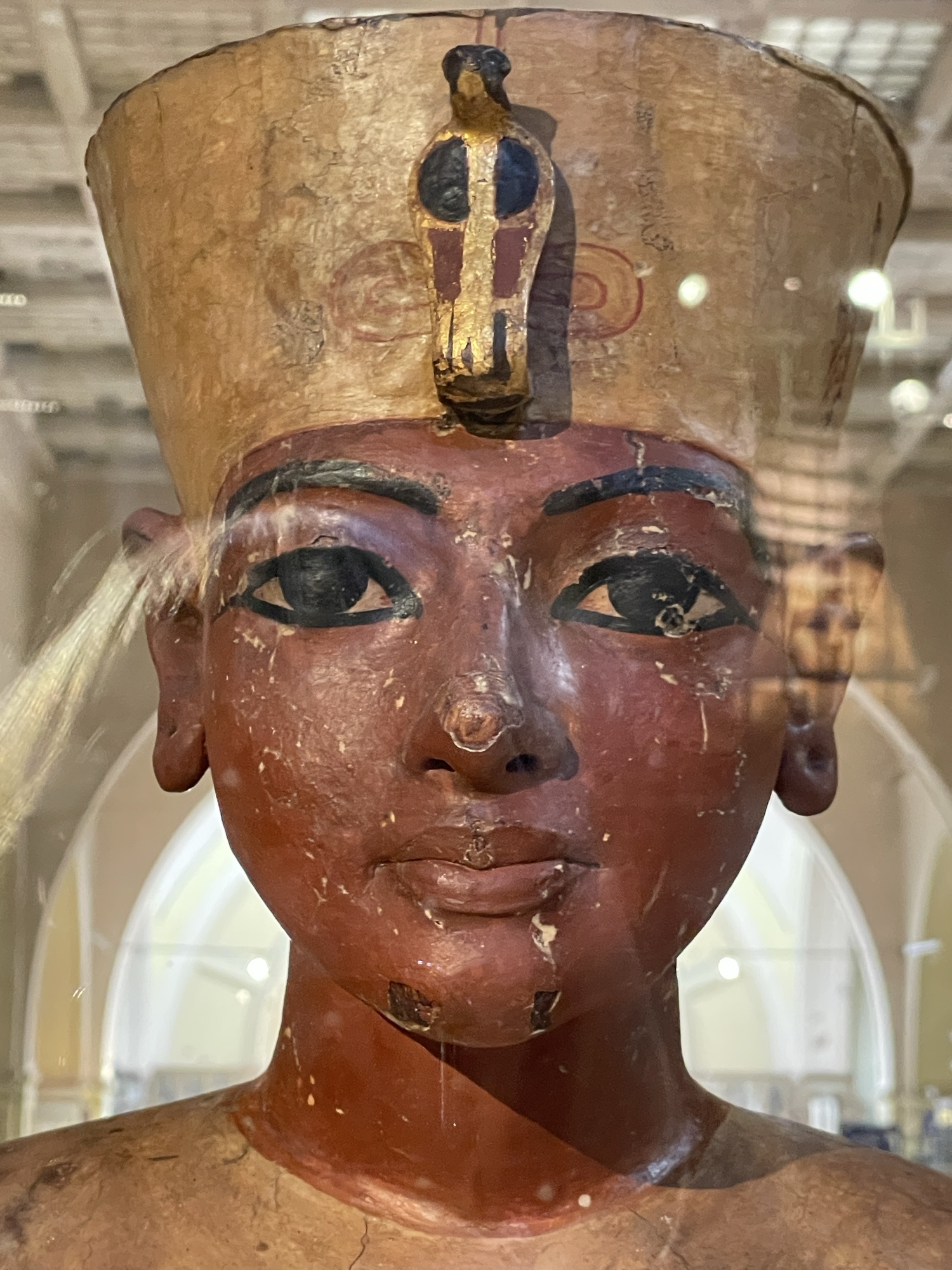
The Egyptian Museum was not only a great reprieve from the unsolicited hawkers, it also provided great preparation for what we would see in Luxor. If you are going to delve into Egypt’s past by visiting the Valley of the Kings in Luxor, then a trip to The Egyptian Museum is a must. At the time we went in February, this museum still had most of Egypt’s antiquities. The new GEM or Grand Egyptian Museum is scheduled to receive a lot of these antiquities but it is still in its soft opening. Only a few objects are on display like the colossal statue of King Ramses.
Purchasing tickets is by credit card only at most museums and monuments. We had no problem getting in at 12:30 on a Sunday. A guide is available for a price, but we found items on display with information plaques written in English.


The following day our friends from the States flew into Cairo. We were going to explore Egypt and navigate this very different culture together. I had shared our tentative itinerary with Hany the day before, listing sights and counting on Uber to get us around. He had insisted that we hire a driver for the day. It would create a seamless experience and cut down on wait times. He found a driver for us and it was an amazing hassle free day.
We had drove out to the National Museum of Egyptian Civilization. Known for its large collection of mummies and state-of-the-art facilities to showcase these 3,000-plus-year-old bodies, we arrived close to opening hours and had the pleasure of finding the facility nearly empty of tourists. With no lines, we purchased our tickets and descended into the darkened tomb-like chambers to view the pharaohs. Historical figures like Ramses II, Nefertari, Thutmose III, and Hatshepsut were on display. There are 20 mummies in all.
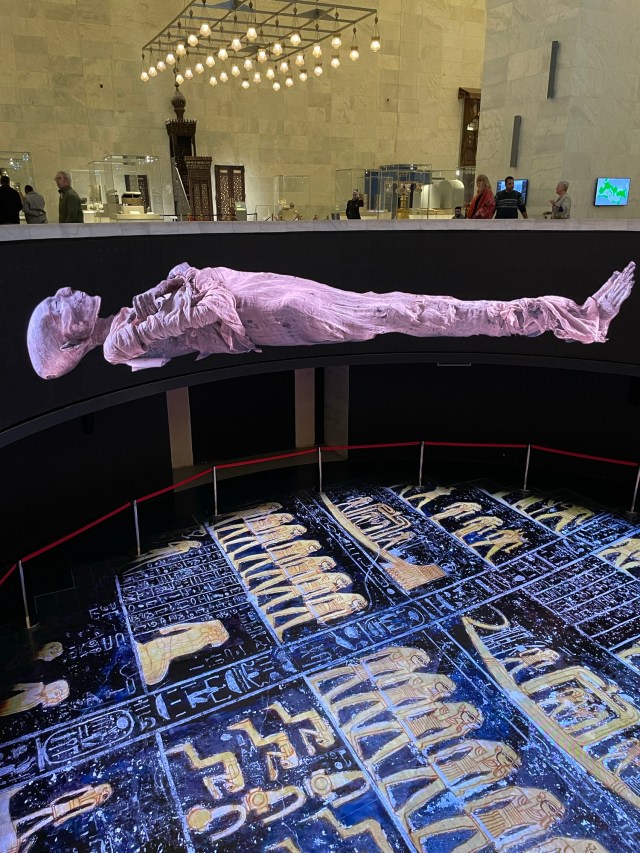
New insights and questions popped into my head just by looking at these amazing bodies. How small most of them were! Had they shrunk over the years? Why were the back of their skulls elongated? Ramses II was tall and had reddish-blonde hair. Was he feared because of his height? Most of the women had delicate noses and cheekbones. Some looked peaceful while others looked in anguish. Why did some mummies have perfectly straight teeth as if they had worn braces while others didn’t? My questions were endless.
Picture-taking is prohibited in the mummy chambers and security made sure the rules were observed. I found that two hours was plenty of time to spend at the museum. There are some antiquities on the upper floor, but nothing compares to the mummies.
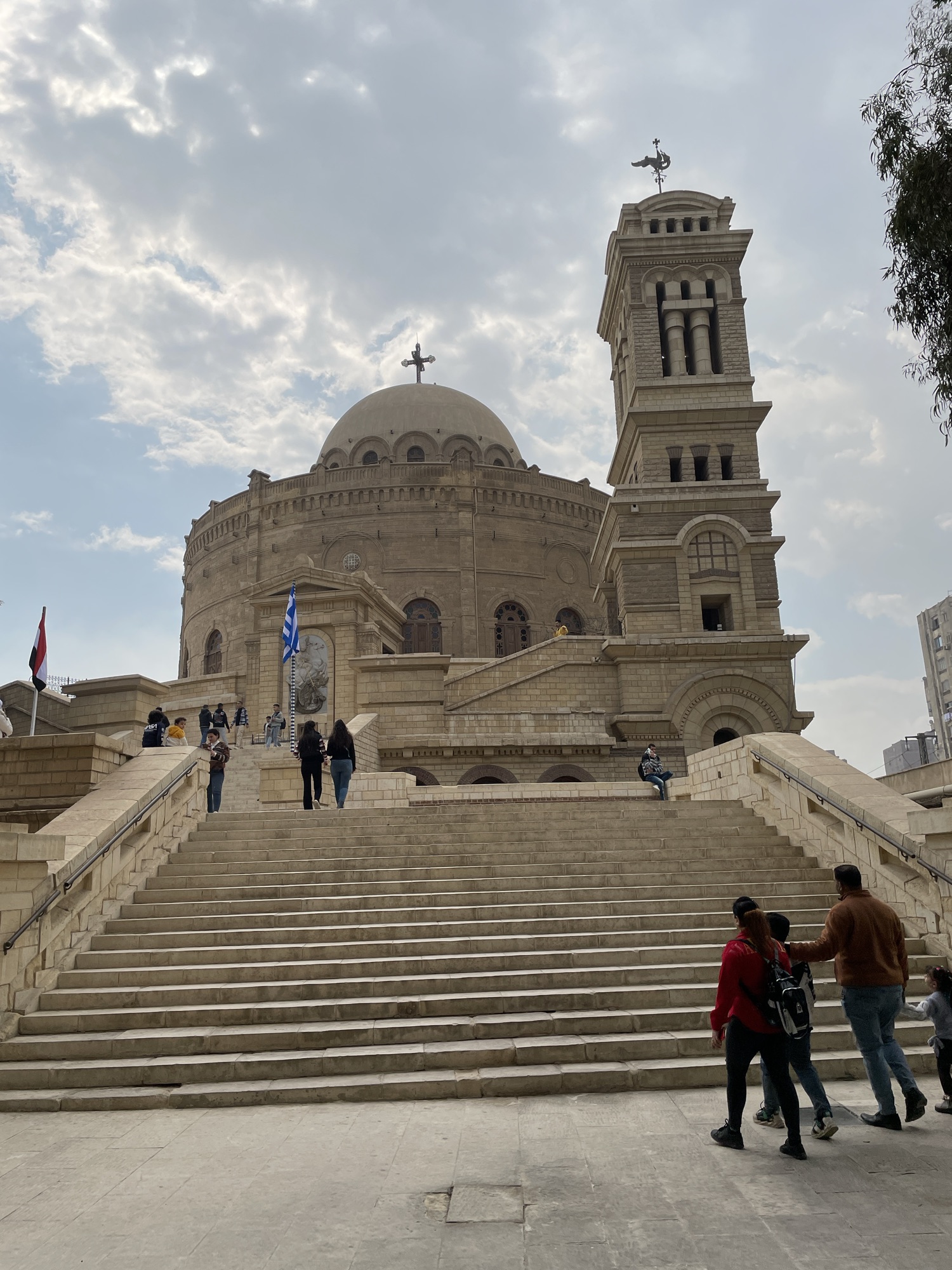
Coptic Cairo was our next stop. With one main street, the area is flanked at each end with police. We passed through barricades and walked along with crowds of tourists. Giftshops and restaurants line the street. St. George, the Hanging Church, and St. Sergius and Bacchus were on our list. Each had their unique history but it was St. Sergius that intrigued us as legend says Jesus, Mary, and Joseph spent some time there in a cavern. Every sight was free and easy to access, but there were lots of stairs to navigate into these structures.
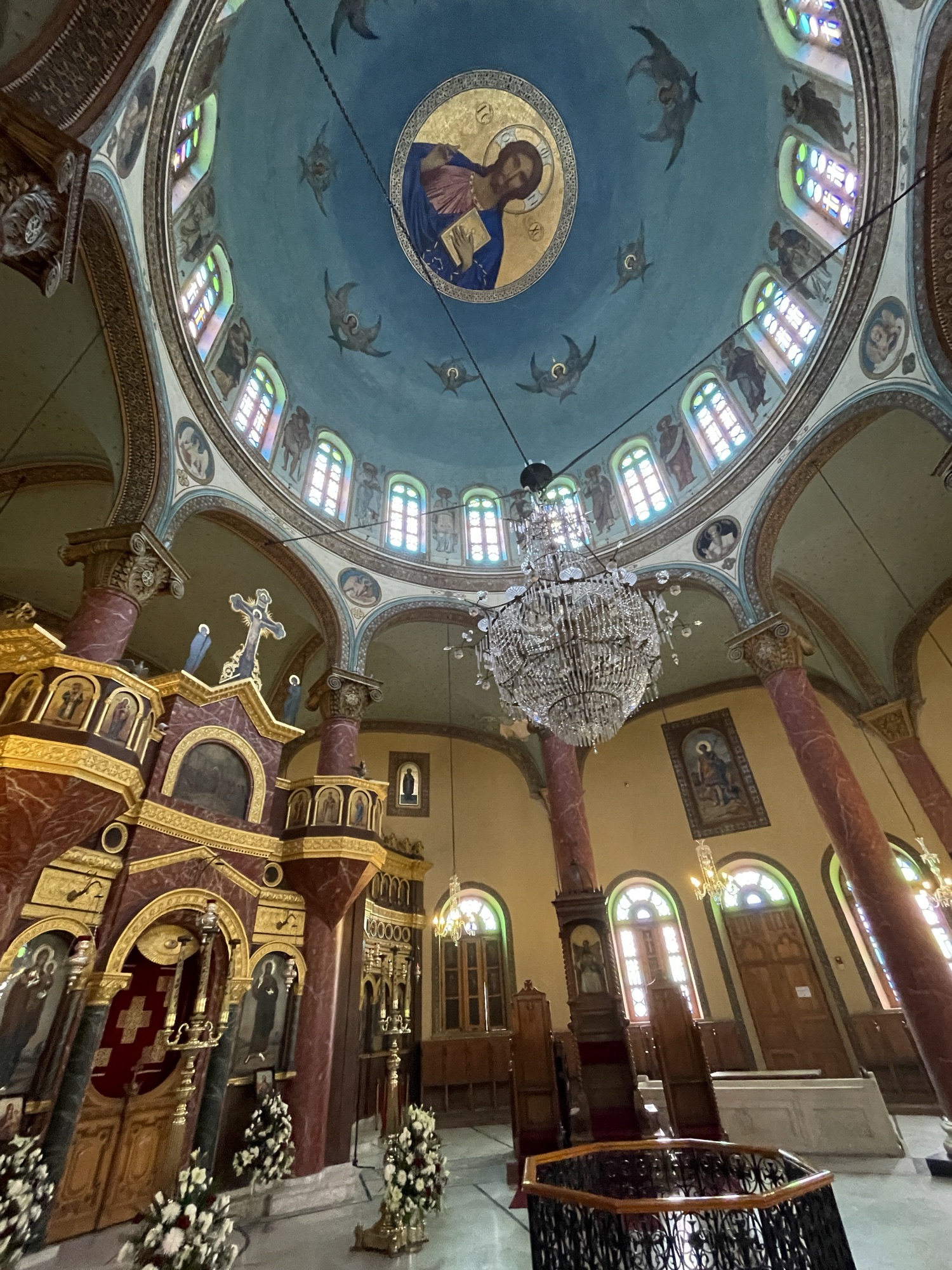
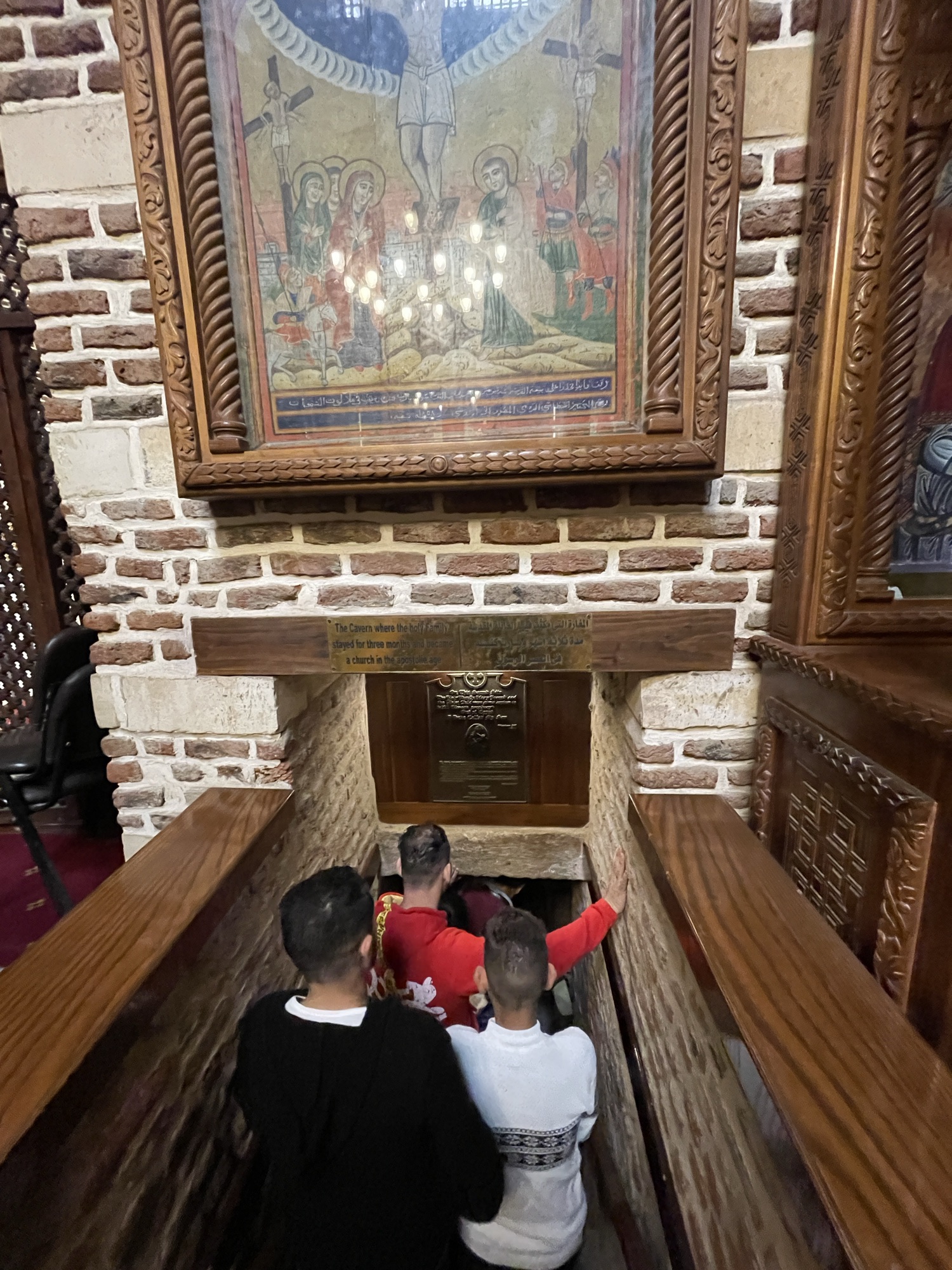
Traffic was chaotic as usual, but the endless honking perplexed us. We asked our driver why was this so prevalent in all of Cairo? He said that drivers were actually communicating with each other on the road. A certain honk meant, “I am coming up on your left.” Another series of honks meant, “Get out of the way. I want to make a turn” while a chirping type of horn meant the driver was really pissed off. It seemed like our driver was joking with us, but we checked with other locals and that was what was going on.
We headed to Islamic Cairo and Al-Azhar Park for a much-needed break. This park is like an oasis in the bustling, crowded city. Built over a mound of rubble by His Highness, the Aga Khan to commemorate the foundations of city walls left behind by his ancestors, the Fatimids in 969, the park overlooks Cairo. There are gardens, fountains, and restaurants inside the park. We stopped for lunch at the Hill Top Restaurant. This indoor/outdoor restaurant has beautiful views of the manicured gardens that slope down the hill, the Citadel can be seen off in the distance, and the surrounding city. We enjoyed the traditional dishes of Egypt, trying Kabobs, Kofta, and local vegetables grilled over a portable coal-burning oven placed at our table.
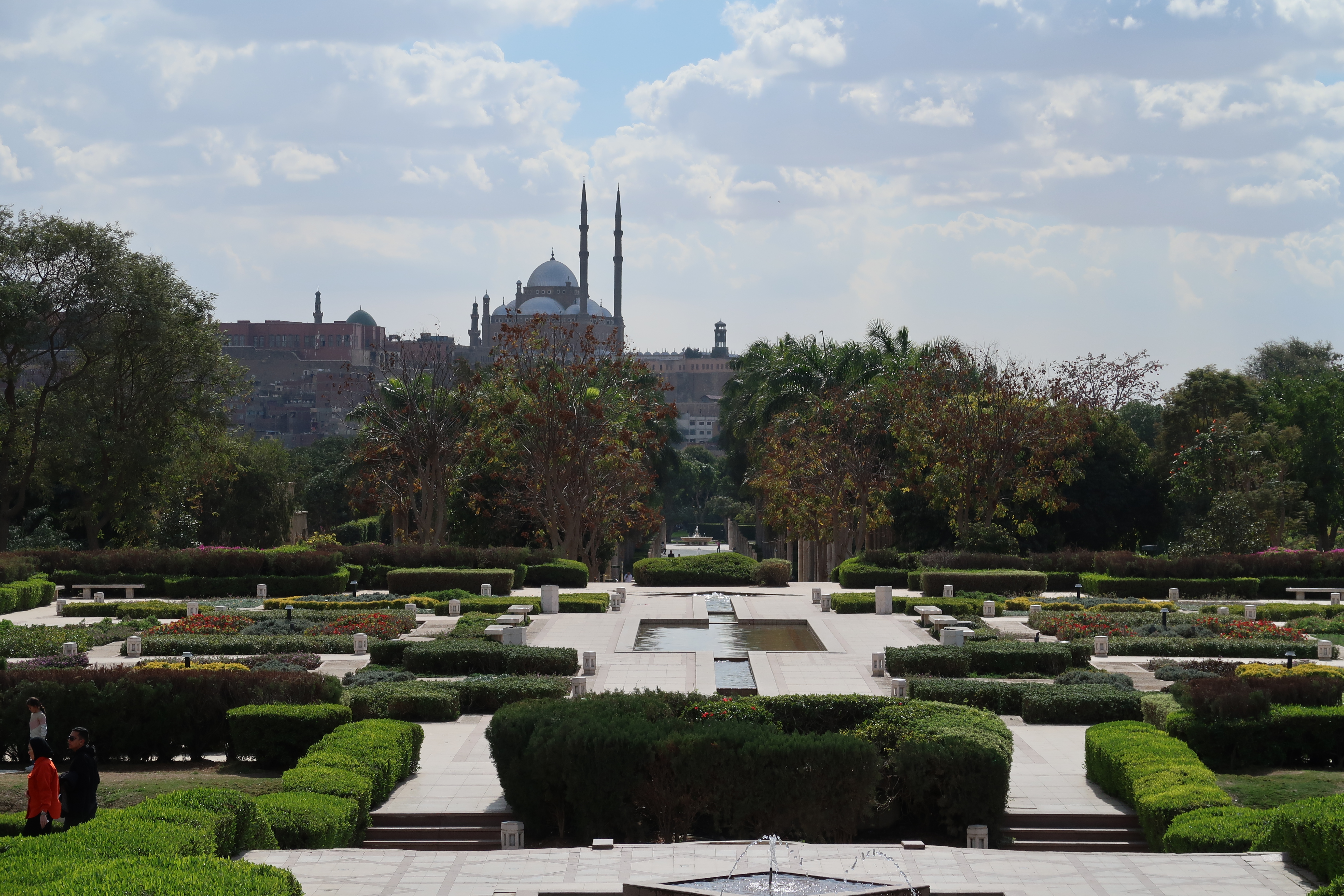

Well rested, we were ready to explore the Cairo Citadel that loomed in the distance. Sitting on top of the Muqattam Hills, it is one of the most iconic structures in Islamic Cairo. Built by Saladin in the 1100s, to protect Cairo and its sister city Fastat from potential Crusader attacks, it was the seat of government for nearly 700 years. Later other structures were built including the massive Muhammad Ali Mosque. This building is truly impressive. Also known as the Alabaster Mosque for its usage of marble and alabaster, it is a beautiful structure. Its minarets are claimed to be the highest in Cairo. Cairo is also nicknamed, “the city of a thousand minarets”.
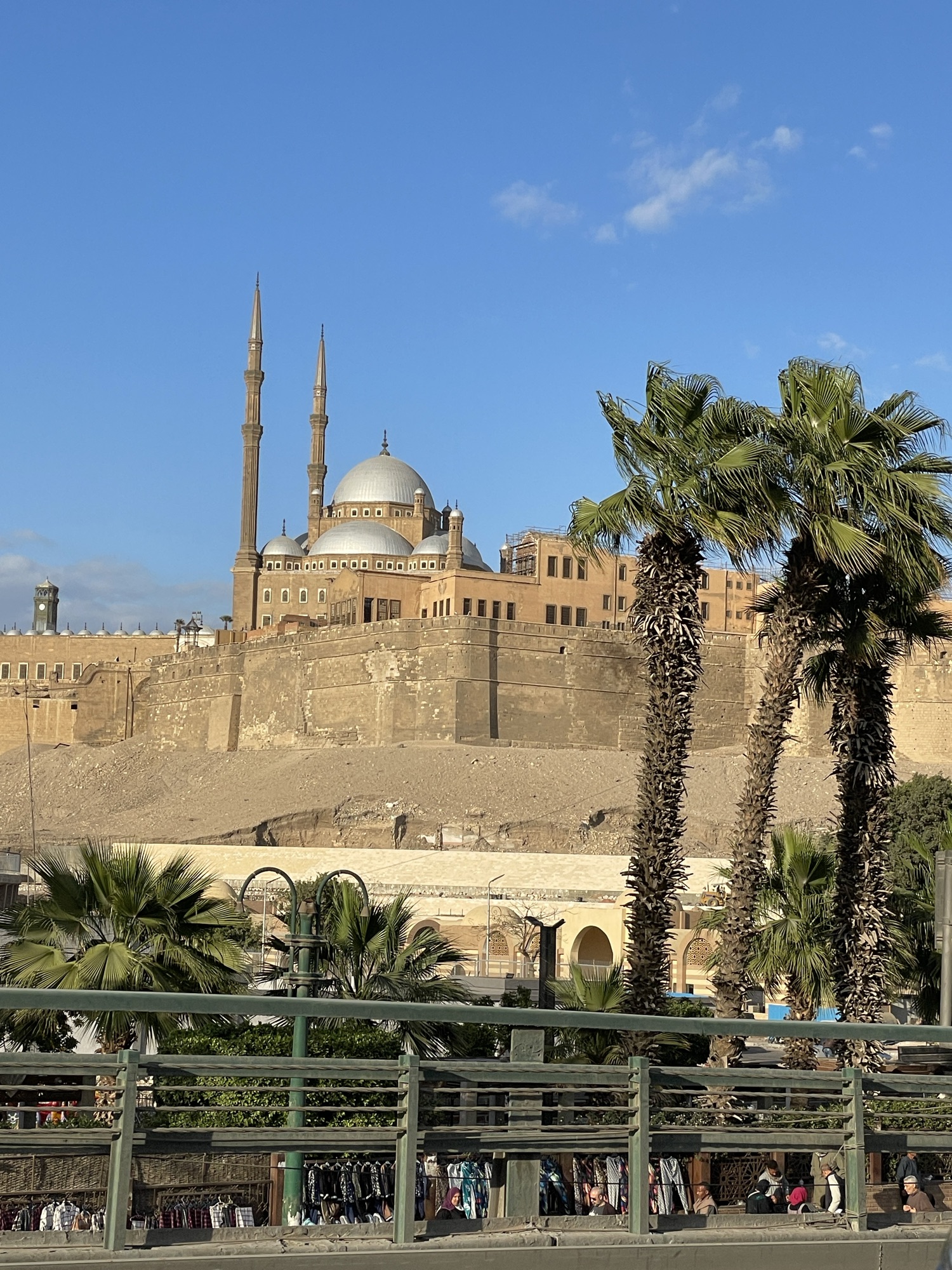
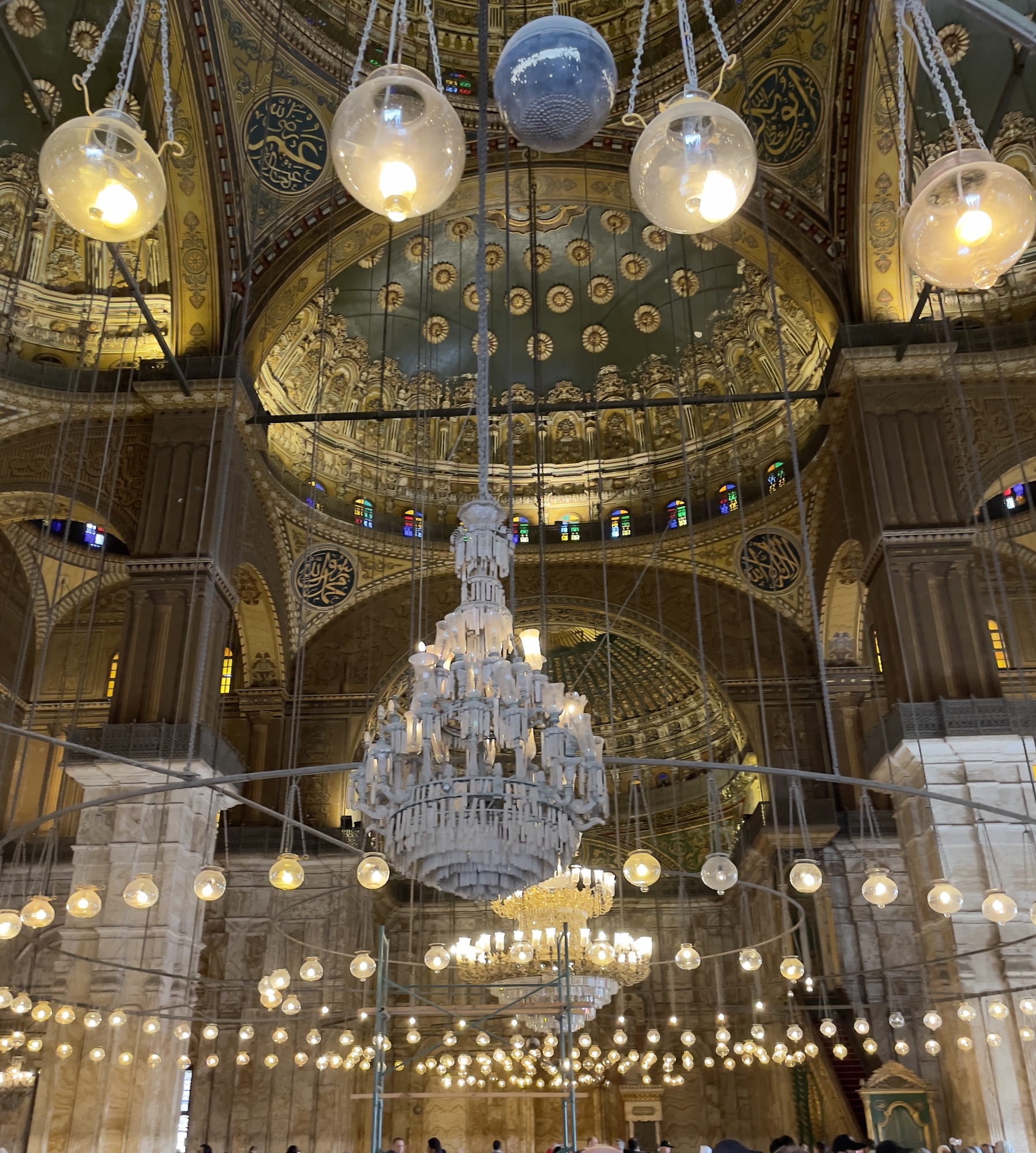
Construction was occurring when we visited the complex where a large wooden platform was being built. But it didn’t hinder our explorations. The Nasir Muhammad Mosque which is across from the Muhammad Ali Mosque seemed abandoned and in disrepair. We spent most of our time in and around the Muhammad Ali Mosque. Its courtyard is impressive along with the interior of the mosque. There is so much to see in this one structure. We lingered long enough to experience “the call to prayer” that our friends read on an app for times throughout the day. It was awe inspiring and something that I would recommend to schedule your visit around.
Passing the Citadel’s towers and thick golden walls, we hopped back into the van and headed for one last attraction, The Khan El Khalili Bazaar.
Like all the major attractions in Cairo, we confidently stepped around police barriers to enter the Khan El Khalili Bazaar. We were adapting to the extra security measures. The bazaar was alive with energy. Perfumers, spice traders, clothiers, incense, brassware, textiles, and trinket vendors filled the street and alleyways with their vibrant open market stalls. The array of colors and fragrances overwhelmed our senses in the most delightful way. Surprisingly, the vendors were not as assertive as we had anticipated. Perhaps it was the late hour of the day, but we were mindful not to engage with anyone overly insistent. When we did pause to browse, the shopkeepers were accommodating and not pushy. Walking through the bazaar felt like a journey through history as we marveled at spices displayed in large barrels, brass lamps reminiscent of Aladdin’s adventures, and intricate rugs adorning the walls. I was intrigued by the juxtaposition of scantly clothed mannequins in belly dancing costumes alongside modern logo sports t-shirts. It was a reminder that the twenty-first century has left its mark on a street that traces its origins back to the fourteenth century.

At 5:30 in the afternoon, we called it a day. I glanced at my iPhone health app and saw that I had walked 11,900 steps. Yep, it was time to go back to the hotel.
Stay tuned for Day 3. We covered almost every pyramid you can get to by a vehicle. The information is vast and interesting. Until then, happy travels.
 Traveling with family & friends and the Power of Prudence
Cairo sounds every bit as chaotic and exhilarating as I expected. Maggie
LikeLike